SEO



If 2024 was the year SEO started feeling unstable, 2025 was the year it officially changed shape.
Search did not break. Rankings did not disappear. And most importantly, SEO did not die.
In 2025, we saw search answers appear without clicks, AI systems choosing which brands to quote, forums outranking polished blog posts, and visibility showing up in places that never appeared in traditional rank trackers.
At the same time, sites doing “everything right” on paper still lost traffic, while others quietly gained influence without obvious ranking wins.
SEO in 2025 stopped being about chasing a single result page. It became about showing up across multiple systems, often without a click, and sometimes without clear reporting.
This recap is not a list of Google announcements or trend predictions.
It is a breakdown of what we actually observed in 2025, backed by data, platform behavior, and real-world patterns, followed by what those changes quietly signal for 2026.
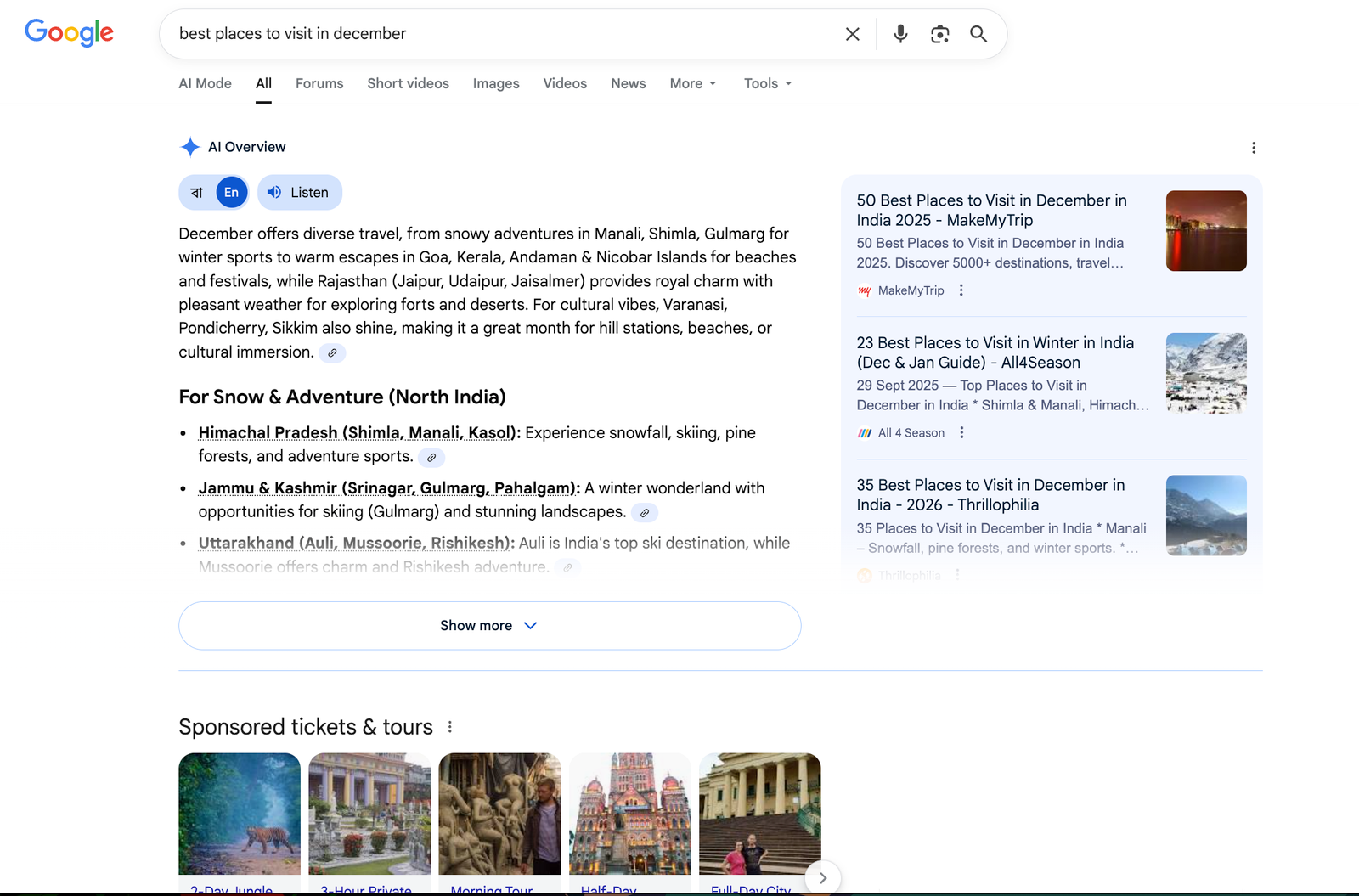
In 2025, AI Overviews stopped feeling like a test and started behaving like infrastructure.
Early in the year, they appeared sporadically. By mid-2025, they were showing up consistently across informational, comparative, and early research queries. Toward the end of the year, their presence stabilized. Not everywhere, not for every keyword, but often enough that ignoring them was no longer an option.
And industry data backed up what many SEOs were already seeing in real SERPs.
Research published by Semrush showed AI Overviews appearing on roughly 6–7% of their 10M+ tracked queries in January 2025, climbing rapidly to close to 25% by mid-year, before settling at around 15–16% toward the end of the year.
That stabilization mattered more than the peak. It signaled that AI Overviews were no longer being trialed. They had found their place.
What mattered was not just how often AI Overviews appeared, but where they appeared.
They showed up most reliably on:
In other words, exactly the part of the funnel where brands traditionally build trust.
One important nuance from 2025 data is this:
AI Overviews did not simply replace organic results. In most cases, they rearranged attention.
Users scanned the AI answer first, then decided whether to:
That behavior shift explains why click patterns became harder to predict. Some pages lost clicks even while staying visible. Others gained influence without ranking changes.
Semrush’s analysis reflected this nuance as well. When comparing the same keywords before and after AI Overviews appeared, zero-click behavior did not spike dramatically, and in some cases even declined slightly.
Therefore, AI answers were not blocking clicks by default. They were changing how users decided to click.
Another critical insight was how AI Overviews sourced information.
They overwhelmingly pulled from:
This wasn’t anecdotal. Data shared by seoClarity showed that more than 99% of sources cited inside AI Overviews came from pages ranking in the top 10 organic results.
That showed a key 2025 reality:
For many sites, this was the first time visibility showed up in Google Search without a corresponding ranking improvement. A page could remain in position 5 or 6 and still become the face of the answer.
That was new.
AI Overviews also exposed weak content faster than before. Pages that relied on vague explanations, padded introductions, or surface-level summaries were rarely cited.
AI Overviews changed how success felt for many websites.
SEO wins were no longer always obvious in rank trackers or click reports. Influence started showing up higher in the SERP, sometimes without a visit, and sometimes without attribution clarity.
For teams stuck measuring SEO only by sessions, this felt like a loss. For teams watching visibility and authority, it felt like evolution.

Once AI Overviews and answer engines became part of everyday search behavior, something else followed naturally.
SEO teams started optimizing not just to rank, but to be chosen as the answer.
That shift is what pushed Answer Engine Optimization (AEO) from a theoretical idea into a practical discipline in 2025.
It was no longer about experimenting with prompts or chasing visibility in isolated tools. It became about structuring content so AI systems could confidently extract, quote, and reference it.
This happened because answer engines behave differently from classic search.
Platforms like Perplexity openly position themselves as citation-first systems. Their interface makes sources visible, clickable, and central to trust. Users are encouraged to verify where answers come from, which means that being cited directly affects traffic and credibility.
At the same time, OpenAI and Google both emphasized that their AI systems rely on external sources to ground responses and reduce hallucinations. That reinforced a simple reality for publishers and brands.
If your content is not clear enough to be extracted, it is unlikely to be cited. If it is not cited, it becomes invisible in answer-first environments.
This is where AEO separated itself from traditional SEO.
Classic SEO focused on:
AEO added new operational requirements:
In practice, this meant content needed to work in isolation.
For example, a paragraph had to make sense even when removed from the page. A definition had to be clear without relying on the surrounding context. Lists, steps, and short explanatory blocks became more valuable because they reduced ambiguity for machines.
There was also a noticeable shift in how success showed up.
Some brands saw modest organic traffic changes but began receiving:
This made AEO feel real, not theoretical.
Another important 2025 lesson was that AEO did not replace SEO. It depended on it.
Multiple studies, including AI Overview citation research, showed that AI systems overwhelmingly referenced content already ranking well organically.
In other words, you could not skip SEO and jump straight to AEO. You had to earn baseline trust first, then optimize for extraction.
Therefore, SEO became the foundation. AEO became the refinement layer.
AEO changed how content was written and evaluated.
Long introductions, vague positioning, and generic summaries became liabilities. Clear answers, strong topical focus, and confident explanations became assets.
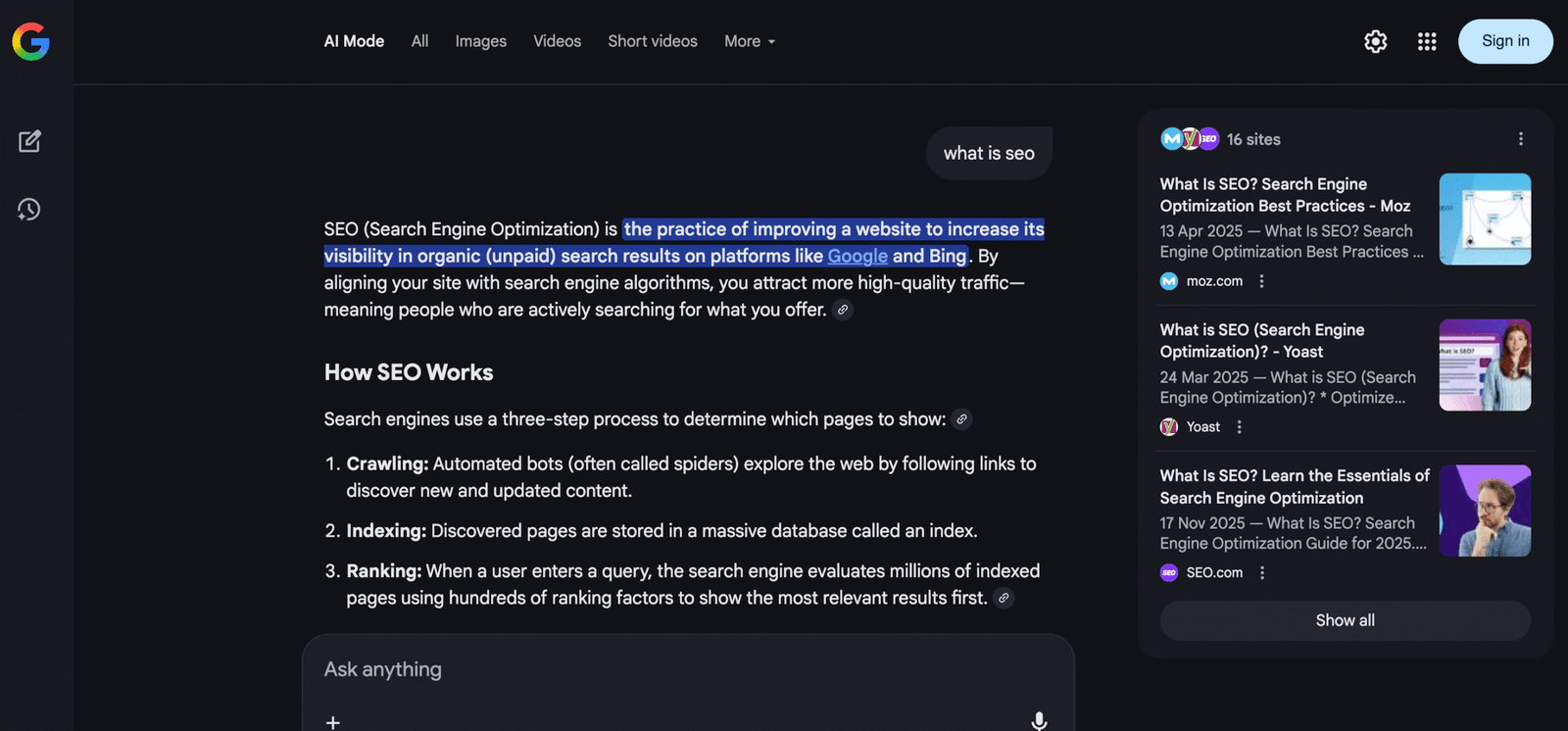
AI is now no longer something layered on top of search. It became part of how search worked by default.
Google stopped treating AI experiences as optional experiments and began integrating them directly into the search journey. AI answers appeared higher, persisted longer, and increasingly shaped what users saw before they ever interacted with classic blue links.
This shift was not limited to AI Overviews alone.
Google expanded AI-driven experiences across:
In effect, search started behaving less like a list of links and more like a guided response system.
One of the most telling signals in 2025 was Google’s willingness to introduce ads inside AI-generated answers. That move made it clear that AI Mode was not a side feature. It was now commercially and strategically central to search.
From Google’s perspective, that decision only makes sense if AI answers are expected to stay.
For SEOs, this changed a long-standing assumption.
Indexing no longer guaranteed visibility.
A page could be:
and still receive less attention if AI answers satisfied the query before a click felt necessary.
This did not mean traditional SEO stopped working. It meant it stopped being sufficient on its own.
SEO still determined:
But AI Mode increasingly determined:
This created a noticeable reporting gap.
Search Console and rank trackers still focused on classic results, while AI-driven visibility showed up inconsistently or not at all in standard metrics.
Many teams felt like something was happening in search that they could see anecdotally but could not fully measure.
That mismatch added to the confusion of 2025.
Some sites did everything “right” from a technical and content standpoint, yet saw traffic flatten. While others gained brand exposure and assisted conversions without obvious ranking improvements.
The difference often came down to how well content fit into AI-driven answer flows.
AI Mode forced a mindset shift.
SEO could no longer be treated as a checklist where indexing, rankings, and links were enough.
Visibility became conditional. It depended on whether your content could participate meaningfully in AI-mediated experiences because that’s where your users are also shifting.
This is also where resilience started to matter more than optimization tricks.
When AI presentation changes, when layouts shift, and when answers appear differently from one month to the next, the only reliable defense is strong fundamentals combined with adaptability.
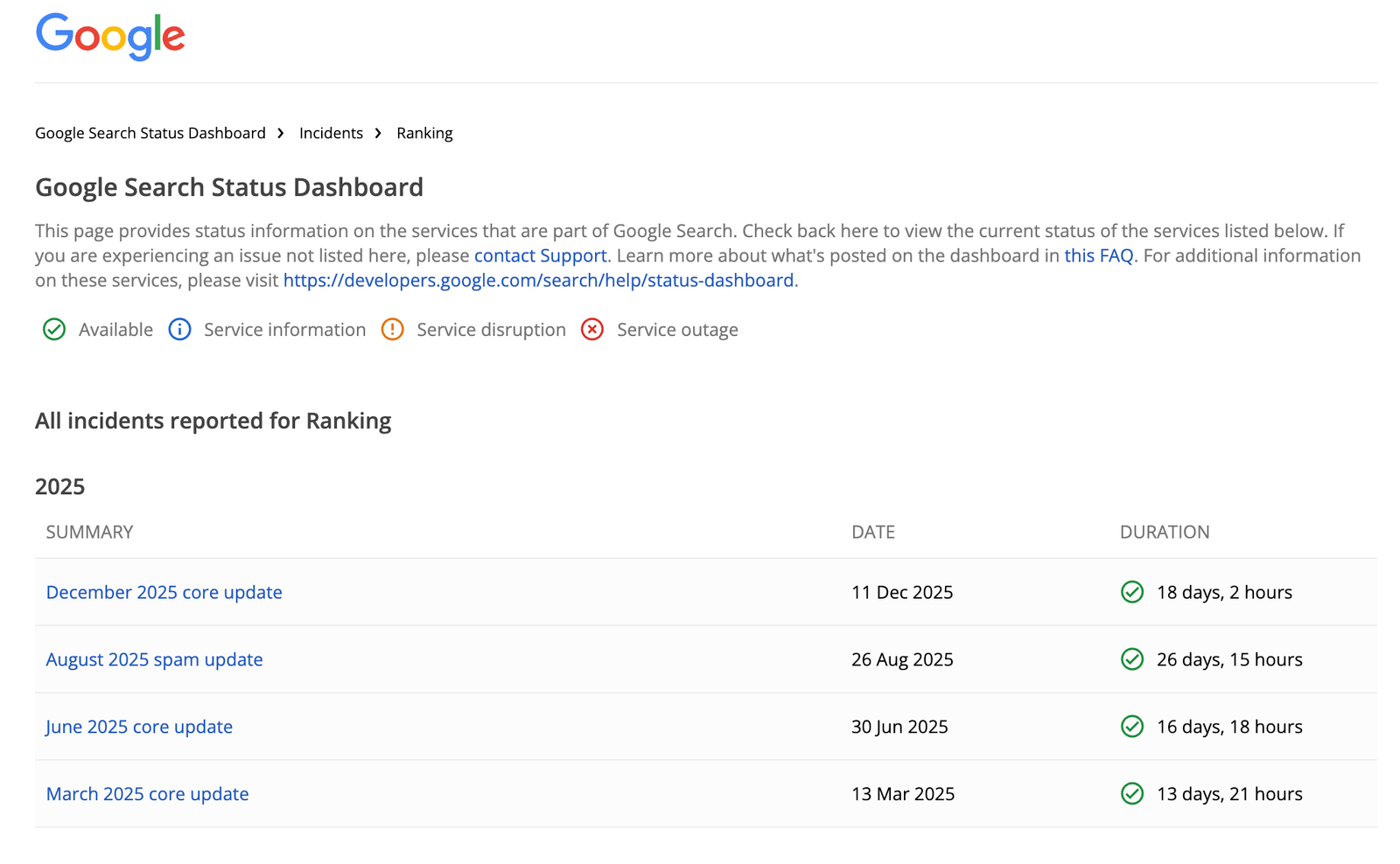
Unlike all other previous years, in 2025, core updates stopped feeling like isolated events and started feeling like a constant background process.
There was no single update that defined the year. Instead, there were multiple core and spam updates, longer rollout windows, and fewer clear explanations around why specific sites moved up or down.
Coverage tracked by Search Engine Journal throughout the year showed a familiar pattern repeating itself:
What changed in 2025 was not just frequency. It was predictability.
In earlier years, sites could often reverse losses by fixing clear issues like thin content, or weak links, or technical problems.
In 2025, that feedback loop weakened. Many sites improved content, cleaned up technical debt, and still saw delayed or partial website traffic recoveries.
This led to a quiet realization across the industry.
Core updates were no longer just recalibrations. They were reinforcing long-term trust signals.
Google appeared to rely more heavily on accumulated signals rather than recent changes. Improvements still mattered, but their impact took longer to surface. I
In some cases, fixes made in Q1 did not show meaningful movement until months later, sometimes aligning with the next major update cycle rather than immediately after.
That lag reshaped how teams worked.
Reactive SEO became riskier. Chasing every ranking dip or spike consumed resources without guaranteed payoff. Instead, stronger performers focused on:
Another noticeable shift was emotional, not technical.
In 2025, fewer updates caused panic. Not because updates were smaller, but because many teams accepted that volatility was now normal. Rankings fluctuated more often, but not all movements required action.
The goal quietly shifted from “recover fast” to “stay stable.”
Frequent Core updates depicted a new SEO reality.
Google was less interested in short-term improvements and more interested in whether a site deserved trust over time. That made quick fixes less effective and made system-level quality more important.
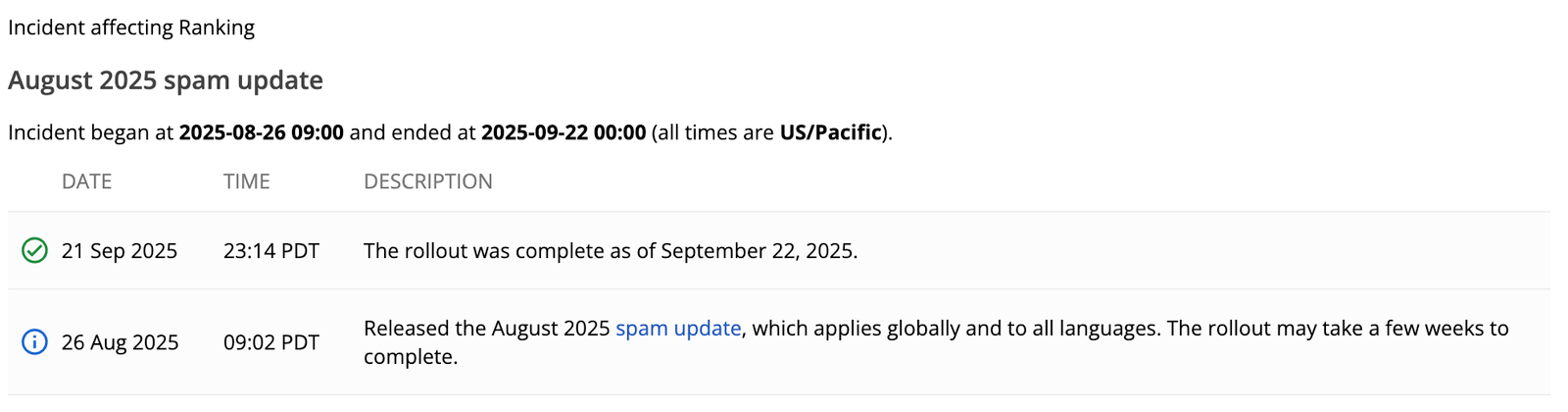
If AI and core updates reshaped how search worked, spam enforcement defined the boundaries of what was no longer acceptable in 2025.
This was the year Google stopped tolerating strategies that leaned on loopholes rather than value.
Throughout 2025, Google expanded and clarified multiple spam policies, especially around:
What made this different from previous years was enforcement consistency. These were not one-off penalties or isolated examples.
Entire sections of sites lost visibility, sometimes without the rest of the domain being affected.
Google’s own guidance made the direction clear: Content hosted on a trusted domain but unrelated to its core purpose was no longer protected by domain authority alone.
Even partial first-party involvement or licensing arrangements were not enough to justify ranking.
That clarification changed how risk was evaluated.
For years, parasite-style strategies worked because they borrowed trust. In 2025, that borrowed trust became a liability. As Google began treating site sections more independently, judging whether they genuinely served users or simply exploited authority.
The impact was visible across multiple industries.
At the same time, enforcement was not indiscriminate.
Sites with:
were far more stable, even when publishing frequently. This reinforced an important distinction.
The problem was not scale itself. The problem was scale without substance.
2025 also marked a shift in how recoveries happened.
Removing or pruning problematic sections often led to gradual improvement, while doubling down on them rarely worked.
For many sites, growth came not from adding more content, but from removing what did not belong.
Spam enforcement forced a reckoning.
Strategies that depended on shortcuts, authority arbitrage, or loosely related content stopped being reliable. SEO became less forgiving of gray areas and more aligned with a site’s actual purpose.
This pushed teams to ask a harder question before publishing.
Does this content belong here?
If the answer was unclear, it was usually risky.
By 2025, “experience” stopped being an abstract quality signal and started showing real performance differences.
For years, many sites competed by summarizing what already existed on the web.
In 2025, that approach quietly lost effectiveness. Content that felt written about a topic started underperforming content written from within the topic.
This aligned closely with how Google framed quality internally.
The Google Quality Rater Guidelines has positioned experience as a distinct signal, separate from expertise or authority. But what changed in 2025 was that this emphasis felt less theoretical and more enforced.
Pages that performed well tended to show:
This was especially visible in:
Meanwhile, generic summaries, even when factually correct, struggled to stand out. AI-generated or human-written content that simply rephrased existing articles often failed to earn visibility, citations, or trust.
This trend became even clearer in AI-driven surfaces.
Answer engines and AI Overviews consistently favored sources that demonstrated lived experience.
Content that included personal insight, real constraints, or nuanced trade-offs was more likely to be cited than content that repeated standard definitions.
In practice, this changed how teams thought about content creation.
The question was no longer just:
“Is this accurate?”
It became:
“Could someone else have written this without doing the work?”
If the answer was yes, the content was at risk.
Another notable shift in 2025 was that experience did not require credentials alone. Many high-performing pages were not written by famous experts or large brands. They were written by people who had clearly done the thing they were describing.
That made experience one of the few signals that was hard to fake at scale.
First-hand experience acted like a quality filter.
It helped search systems, including AI-driven ones, distinguish between content created to rank and content created to help.
As automation increased across the web, this distinction became more valuable, not less.
Experience also gave brands a defensible edge. It is easier to copy structure, keywords, or formatting than it is to copy lived insight.
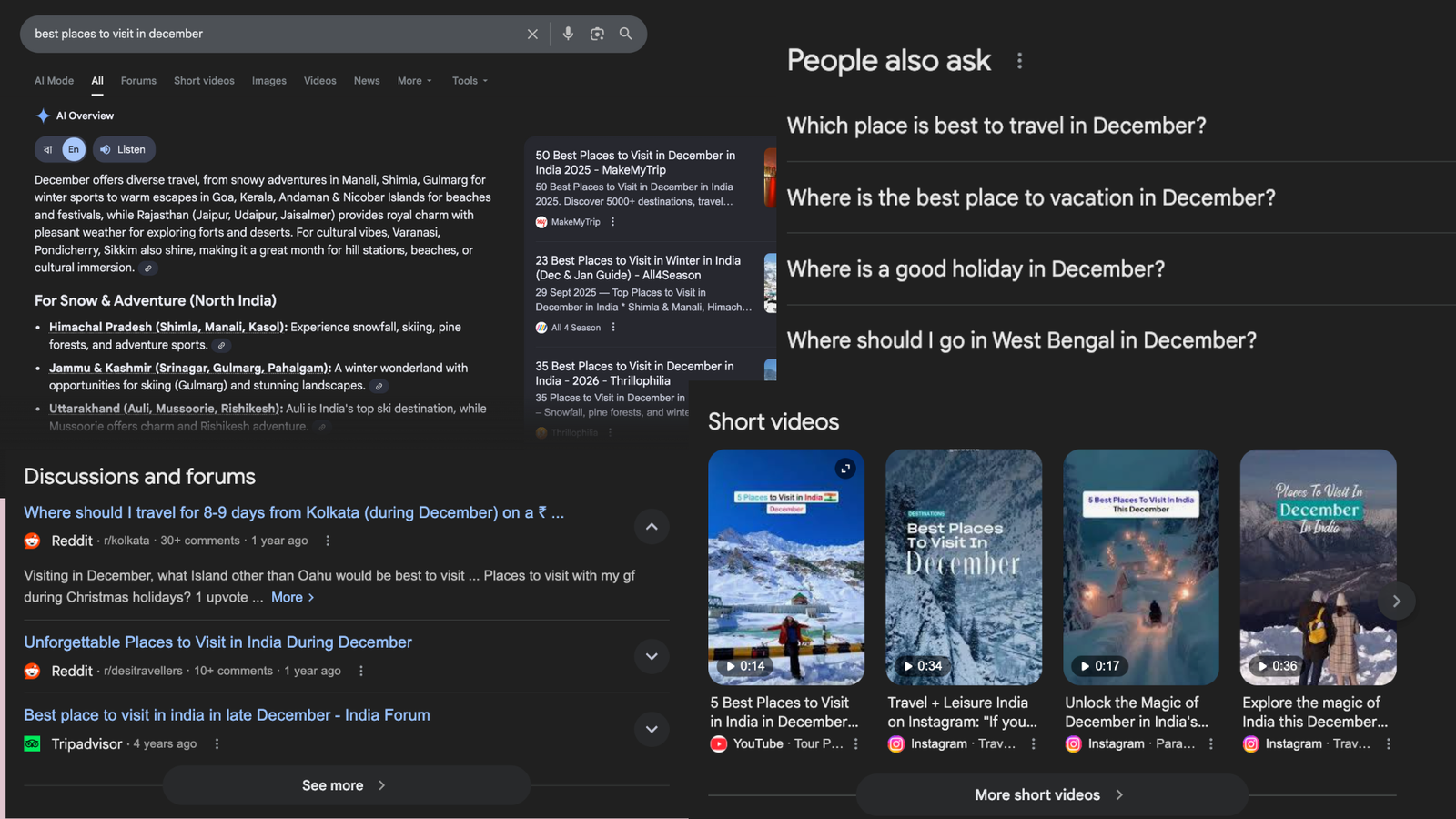
In 2025, one of the quietest but most disruptive changes in SEO was this: the idea of a single, stable SERP stopped being reliable.
The same keyword could produce noticeably different results depending on:
This wasn’t personalization in the old sense. It was an intent interpretation at scale.
Data from multiple SEO platforms showed rising volatility in SERP layouts even when rankings appeared unchanged.
Tools like Semrush and Sistrix reported increased fluctuation in SERP features across identical keyword sets, suggesting that Google was testing how to answer queries, not just which page to rank.
In practice, this meant one query could surface:
And another user searching the same term could see a different combination.
This fragmentation changed how visibility worked.
Ranking number 3 no longer guaranteed consistent exposure.
A page might rank well and still be pushed below AI answers, videos, or community results.
At the same time, content that never reached top positions could gain visibility through featured placements or AI citations.
The format of content began to matter as much as the topic itself.
Google increasingly matched format to intent:
This was not random. It reflected how users actually consume information.
From an SEO perspective, this made traditional rank tracking less dependable. Tracking “position” captured only part of the story. What mattered more was:
Many teams began shifting from asking, “Where do we rank?” to asking, “Where do we show up?”
This also explains why some sites felt invisible despite stable rankings, while others felt present without obvious ranking gains.
Visibility became distributed across formats, not concentrated in one list.
SERP fragmentation guided SEOs to broaden their definition of optimization.
Optimizing only for blue links became limiting. To stay visible, content needed to:
SEO started blending more deeply with content strategy, video, UX, and even brand presence outside the site.
How content was presented started to matter almost as much as what it said.
This was not a sudden change, but it became impossible to ignore as AI-driven surfaces expanded.
Content that was hard to scan, poorly structured, or overly narrative struggled to surface, even when the underlying information was solid.
Clear structure became a visibility signal.
Pages that performed well across AI Overviews, featured snippets, and answer engines typically shared a few traits:
When AI systems and SERP features extract information, clarity becomes a competitive advantage.
Research into AI Overview sourcing patterns consistently showed preference for content that could be cleanly lifted and summarized.
Dense paragraphs, long introductions, and buried answers created friction. Well-structured content lowered it.
At the same time, format diversity started playing a larger role.
Google increasingly surfaced different formats based on intent:
Platforms like YouTube, Reddit, and niche communities appeared more frequently alongside traditional articles, especially when users were exploring rather than deciding.
This pushed SEO beyond page optimization and into format strategy.
A single topic could no longer be fully owned by one article. Visibility often required:
UX also became part of the equation.
Pages that loaded quickly, presented information cleanly, and avoided clutter were easier for both users and systems to process.
While Core Web Vitals were not new in 2025, their indirect influence became more apparent as AI-driven surfaces favored content that could be consumed quickly and confidently.
What changed was the mindset.
SEO stopped being only about optimizing pages and started becoming about designing answers.
Structure and format determined whether content could travel.
Well-structured content moved easily across:
Poorly structured content stayed confined to traditional listings, where competition was often highest.
Multi-modal presence also reduced dependency on any single surface. When blue links lost attention, other formats picked up the slack.
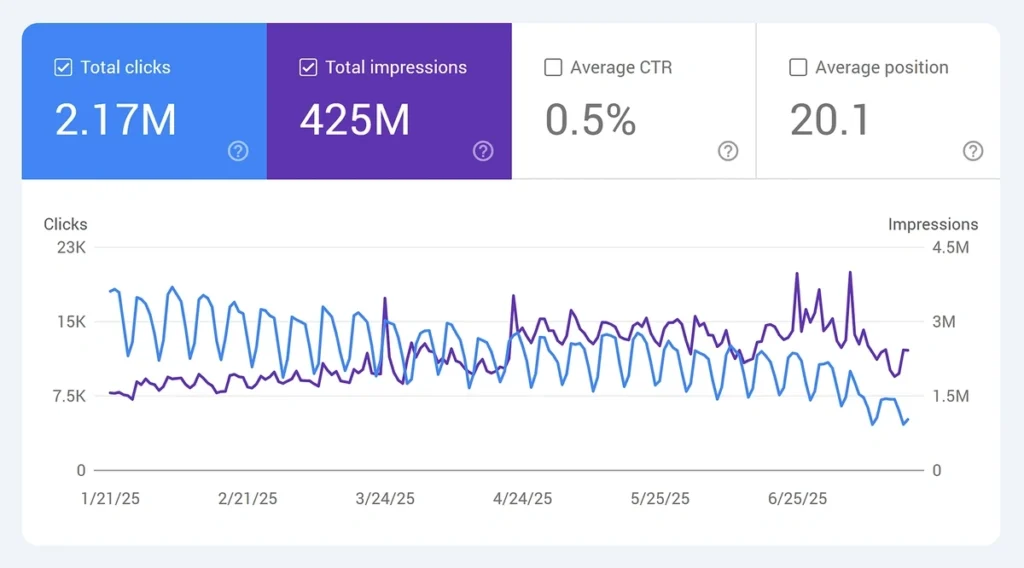
Image Source: Exploding Topics Blog: The Great Decoupling
By the end of 2025, one thing became clear across industries: being visible no longer guaranteed being clicked.
This was not because search suddenly became “zero-click by default.”
In fact, multiple studies showed that clicks did not collapse across the board. What changed was where attention was captured.
AI Overviews, rich SERP features, expanded PAA sections, video carousels, and community results increasingly satisfied user intent before a traditional click felt necessary. Users still discovered brands, but the interaction often stopped at visibility.
This created a disconnect that many SEO teams struggled with.
Pages could:
and still show flat or declining organic traffic.
While AI Overviews did not trigger a dramatic rise in zero-click searches overall, they shifted user behavior. Users scanned answers first, then chose selectively when to engage further.
At the same time, Search Console data across many sites showed a familiar trend:
This was not a failure. It was a measurement mismatch.
SEO had long been judged primarily by sessions. In 2025, that metric alone stopped telling the full story.
Brands began noticing downstream effects instead:
In other words, SEO started behaving less like a direct-response channel and more like a visibility and influence channel.
This made teams rethink what success looked like.
Instead of asking only:
“Did this page drive traffic?”
Teams started asking:
This shift also explained why some strategies felt frustrating but effective at the same time.
SEO work was clearly doing something, just not always in ways legacy metrics captured cleanly.
The decoupling of visibility and clicks changed how SEO was justified, reported, and prioritized.
It pushed teams to:
If 2025 was the year search changed shape, 2026 will be the year teams are forced to adapt to that shape intentionally.
The signals from 2025 are already clear:
2026 will not be about chasing every new surface or feature. It will be about building content and systems that hold up across changing interfaces.
Most importantly, SEO in 2026 will reward teams that stop treating search as a channel and start treating it as an ecosystem.

AI Services





Link Building






Resources