SaaS

You’ve done the work. Your blog is active, your G2 profile has solid reviews, and you rank on page one for a handful of competitive keywords.
Then one afternoon, out of curiosity, you open ChatGPT and type: “What’s the best project management tool for a remote engineering team?”
Your product doesn’t appear.
A competitor you’ve been outranking on Google for two years gets recommended instead.
Not because their product is better.
Not because their content is stronger.
But because somewhere along the way, they built the kind of presence that AI systems are trained to trust and you didn’t.
This isn’t a fluke. It’s a structural shift.
The way AI answers get built is fundamentally different from the way search results get ranked. And most SaaS teams are still optimising for the wrong game.
This is what AEO for SaaS companies actually requires, and it starts somewhere most SaaS teams haven’t looked yet.
AEO or Answer Engine Optimisation is simple in concept and hard in practice.
The goal isn’t to rank in a list of ten results. It’s to be the answer when someone asks an AI a question.
ChatGPT, Perplexity, Google AI Overviews, and similar platforms don’t show links and let users decide. They synthesise from multiple sources, form a response, and occasionally cite a handful of those sources.
The question is whether your brand makes it into that synthesis.
For SaaS, this matters in a specific way.
AEO demands greater emphasis on technical accuracy and industry authority. Decision-makers ask increasingly specific questions about implementation, integration capabilities, and ROI calculations.
We know that no one is typing “CRM software” into ChatGPT. Instead they’re asking things like: “What CRM works best for a 10-person remote sales team that needs Slack and HubSpot integration?”
Traditional SEO optimises for keywords. AEO optimises for those full-sentence, intent-loaded queries, the kind that arrive when a buyer is already close to a decision.
That last point matters more than most SaaS leaders realise.
When someone asks Google “best CRM for small business,” they’re beginning research. When someone asks ChatGPT the same question, they’re often ready to shortlist and buy.
LLM visitors convert 4.4x better than organic search visitors. Hence this is not a traffic argument. It’s a pipeline argument.
Here’s the uncomfortable truth: most SaaS companies, even well-funded ones with mature content operations, are largely absent from AI-generated answers.
Not because their products aren’t good. Because AI answers for SaaS are being built from a citation ecosystem that most SaaS marketing teams have not thought about strategically yet.
Between February and June 2025, research captured 5.7 million citation links from ChatGPT, Gemini, Claude, and Perplexity and isolated those tied to B2B SaaS products across categories like MarTech, Project Management, HR, CRM, and Collaboration.
The findings are striking.
Over 35% of LLM citations for B2B SaaS come from just 10 sources. Reddit and G2 dominate the citation landscape. Reddit with 6,326 citations and G2 with 6,097 across the top citation lists.
Actual SaaS brand domains are almost entirely absent from the top cited sources. It’s not because they aren’t publishing content, it’s because they aren’t being cited by LLMs.
Read that again. The brands spending the most on content are the ones least likely to show up.
Each AI platform has its own citation personality.
ChatGPT prioritises UGC, community, and review sites like Reddit, G2, PCMag, and Gartner are prominent.
Gemini tilts toward affiliate sources, listicles, and editorial roundups like PCMag, Capterra, and TechRadar all feature prominently.
Perplexity favours recent, well-structured content from authoritative sources and has some of the highest conversion rates among AI platforms, particularly for SaaS products.
Understanding this by platform is the difference between a scattershot content strategy and one that actually moves your citation numbers.
Review platforms matter, but not in the way most SaaS teams think.
100% of the SaaS tools mentioned in ChatGPT answers had reviews on Capterra, and 99% had reviews on G2. These platforms serve as a basic inclusion signal. So if your tool isn’t listed on them, you’re likely excluded altogether.
But here’s where the nuance matters.
More reviews give a slight edge, but low-review tools can still outrank giants. Tools with just a few hundred reviews often appear above those with tens of thousands.
It’s not about volume alone, it’s about how and where you’re mentioned. Being on G2 gets you in the room. It doesn’t guarantee you a seat at the table.
Getting cited by AI is less about gaming a system and more about building the kind of presence that deserves to be cited. There are four moves that actually matter.
Before content strategy, before schema markup, there’s a more fundamental question:
Does the AI even have a coherent understanding of what your product is?
AI models build a picture of your brand from fragmented sources. If your brand description varies significantly between your website, your LinkedIn company page, your Crunchbase profile, and how journalists describe you, the model has conflicting signals.
Conflicting signals reduce confidence, and low confidence means lower citation frequency.
The fix isn’t complex, but it requires discipline.
Define your product in one precise sentence. Pick one term for your product category and use it everywhere. Make sure your website, G2 profile, LinkedIn, Crunchbase, and any press coverage all describe your company with consistent language.
Check your presence on Wikipedia (create an entry if you qualify and don’t have one), Wikidata, Crunchbase, LinkedIn, and any relevant industry directories. Every one of these should tell the same story about your product.
This is foundational infrastructure. Without it, the content tactics that follow don’t stick.
SaaS companies build dynamic, JavaScript-heavy products, and often build their marketing sites to match.
It’s a natural consequence of having engineering-led teams. But it creates a specific vulnerability for AI visibility.
Server-side rendering has become crucial for AI visibility. Many AI crawlers struggle with JavaScript-heavy sites that rely on client-side rendering.
Pages that load content dynamically may appear blank to these crawlers, resulting in zero citations despite quality content.
Your most important pages like product overview, use cases, integrations, pricing, could be invisible to every AI crawler that matters, while looking perfectly fine to a human visitor.
LLMs need to be able to crawl your website to share your content. Without access to your site’s content, AI platforms cannot surface your brand in responses. Verify your crawlability by checking your robots.txt is not blocking LLM crawlers.
ChatGPT uses GPTBot. Perplexity uses PerplexityBot. Check both are allowed. Then confirm your key pages render their content server-side, not through client-side JavaScript execution.
This is a five-minute audit that most SaaS teams might have never done.
Content architecture for AEO citation is meaningfully different from content architecture for SEO ranking.
The goal isn’t to satisfy a crawler looking for keywords, rather it’s to give an AI model an extractable, quotable answer it can drop into a response with confidence.
44.2% of all LLM citations come from the first 30% of a piece of text. 31.1% come from the middle section, and 24.7% from the conclusion.
The implication is clear: front-load your answers. Don’t build to a conclusion. State what you know at the top, then support it.
The most significant shift in 2026’s AEO landscape is the prioritisation of structured content formats that AI systems can easily parse. Answer engines now favour content with clear question-and-answer patterns, FAQ schemas, and tabular data.
For SaaS specifically, this means rewriting product pages so they mirror how buyers actually ask questions.
For example: “Does [product] integrate with Salesforce?” is a better heading than “[Product] Integrations.” Dedicated comparison pages, use-case pages by role and industry vertical, and honest “alternatives to” pages are all formats that AI models cite readily.
AI systems increasingly personalise responses based on user context, industry, and specific use cases. Brands that create dedicated pages for each audience segment, industry vertical, and application scenario position themselves for citation in highly targeted queries.
Analysis of LLM citation patterns shows that granular, audience-specific pages receive 2.3x more citations than generic product pages when responding to targeted queries.
AI models heavily favour content that contains data points and statistics that cannot be found elsewhere. If you publish a survey, a benchmark report, or a case study with real numbers, you become a primary source.
Primary sources get cited far more often than content that aggregates existing information.
For SaaS companies, this means turning your internal data into public content. Data like customer success metrics, industry benchmarks, product usage data, market surveys, etc.
Finally, content freshness is not optional. As answer engines have a strong recency bias.
From real-world citation data, content that becomes more than three months old sees AI citations drop sharply. Revisit important pages at least once per quarter, update statistics, refresh examples, and add recent developments.
Your own website is a weaker signal than you think.
Your website content trains future AI models on your brand, but current AI systems are trained on data that may be months or years old.
More critically, your own website carries less weight in AI training data than third-party sources writing about you.
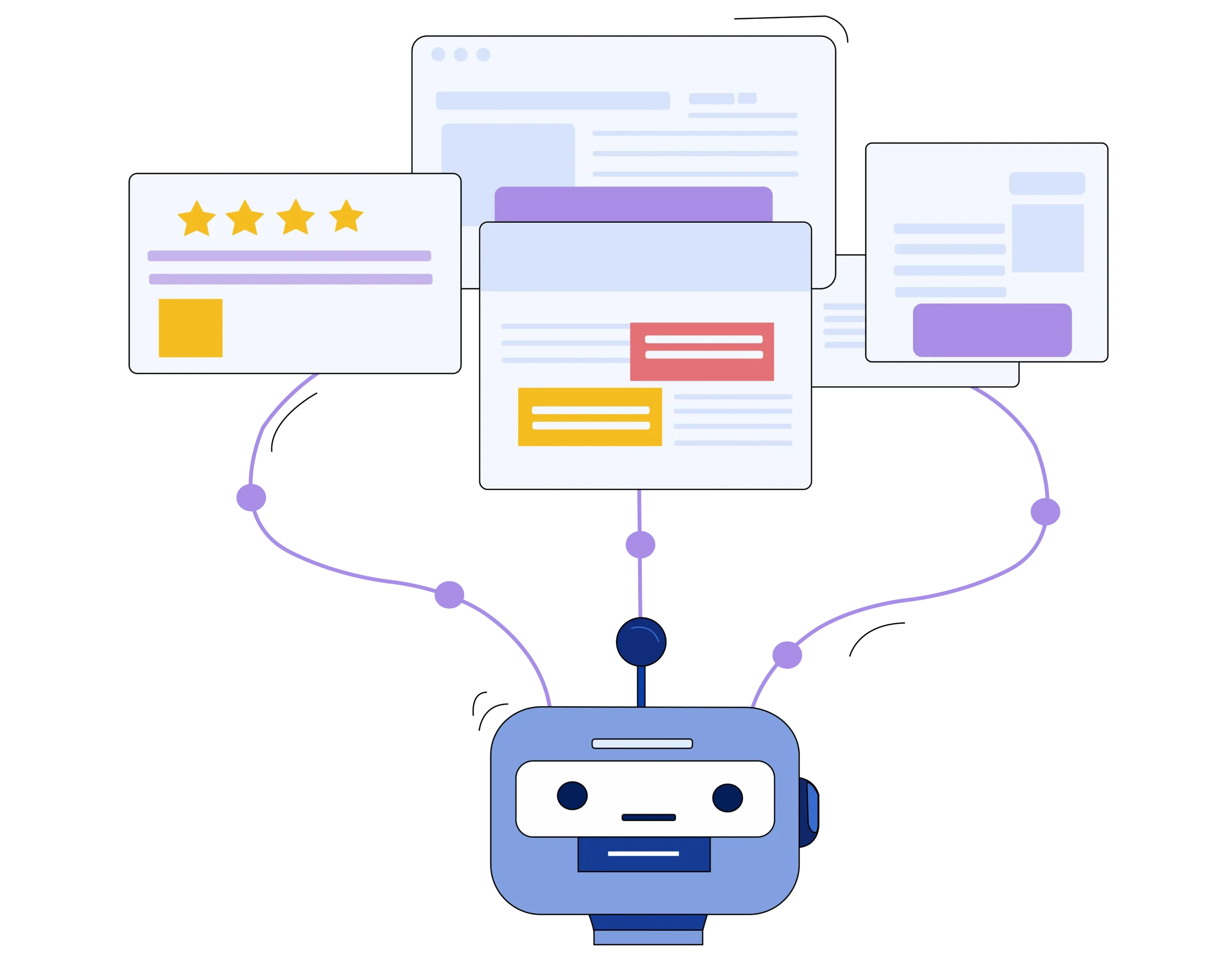
The three external channels that move the needle for SaaS brands are review platforms, Reddit, and earned media.
Domains with profiles on platforms like Trustpilot, G2, Capterra, Sitejabber, and Yelp have 3x higher chances of being chosen by ChatGPT as a source, compared to sites without such presence.
But don’t just exist on these platforms. Actively encourage customers to leave reviews that describe specific use cases, workflows, and outcomes. The language in those reviews is what AI models find useful and citable.
Reddit ranks in Google’s top five for 76% of high-intent SaaS searches. That visibility means AI engines likely pull context from Reddit’s content during training data collection.
This makes Reddit an indirect but powerful factor in LLM optimisation.
The approach that works here isn’t promotional posting, it’s genuine participation.
Founders, engineers, and customer success teams answering real questions in relevant subreddits build the kind of authentic presence that AI systems treat as community-validated expertise.
Every article in a publication that trains AI models is an opportunity to shape what the model knows about your brand.
This makes earned media strategy a direct input to AI citation performance, not just a brand awareness tactic.
Prioritise coverage in major industry trade publications, national business press, and respected tech outlets. A feature in TechCrunch or a mention in a Harvard Business Review case study carries enormous weight as training data.
One strong placement in a high-authority publication outperforms dozens of press release syndications.
Distributing content to a wide range of publications can increase AI citations by up to 325% compared to only publishing content on your own site.
That number should reshape how SaaS marketing budgets are allocated.
Your existing analytics dashboard doesn’t show you what matters in AI search. You need a new layer of measurement.
The metrics that matter for SaaS AEO are:
Tools built specifically for this: Profound, SE Ranking’s AI visibility module, LLMrefs, and Semrush’s AI Toolkit all track brand citations across ChatGPT, Perplexity, Gemini, and Claude.
LLM visitors often show higher engagement rates because they arrive with specific, qualified intent, which means tracking this channel separately from general organic traffic will give you a cleaner picture of pipeline quality, not just volume.
The simplest starting point costs nothing.
Audit the buying questions in your space. Ask ChatGPT and Perplexity the questions your buyers would ask.
Note which brands get cited and how those citations are structured. Then build content that answers the same questions more thoroughly.
That’s your baseline and your competitive intelligence in one exercise.
Only 32% of enterprise marketers feel confident they can diagnose when or why their brand disappears from an AI answer block.
If you can do that, you already have an advantage over most of your competitors.
Here’s what makes this moment different from every other channel shift SaaS marketers have tackled.
Early visibility in AI search compounds into a long-term moat. The brands optimising now like cleaning data, earning authoritative citations, tracking AI presence, will own the narrative as AI platforms mature.
Like early SEO adopters, those who move first in AI visibility will enjoy disproportionate mindshare later.
Early movers in B2B are already establishing citation dominance in their categories. And once AI models learn to associate your brand with specific topics, that advantage compounds rapidly.
The model doesn’t just cite you for one query. It starts surfacing you for adjacent queries too. Every citation makes the next one more likely.
There’s also a risk that doesn’t show up in your current reporting.
A competitor who barely ranks on Google today could be dominating AI answers if they’ve spent the last year building Reddit presence, earning TechCrunch mentions, and structuring their content for extraction.
Gartner predicts classic web-search traffic will drop 25% by 2026 as users shift to conversational answers.
Traditional rankings are not a proxy for AI visibility. You need to audit both, separately, now and treat them as two different games.
The SaaS companies that treat this as a “we’ll get to it” item are already falling behind. Not dramatically, not yet.
But the gap is opening, and it will be harder to close the longer it’s left.
Content is the foundation on which all marketing activities are based. And that is no different for the...
Read Case Study
AI Services




Link Building




Resources