SaaS


Most SaaS founders frame this as a money question.
It isn’t. It’s a stage question. A speed question. And in 2026, it has become an expertise question more than ever before.
Hiring in-house feels like control. And control feels like a smart bet when organic search drives more than half of all website traffic and your competitors are compounding their authority every month.
But control over a single person stretched across technical SEO, content strategy, link building, and now AI search optimization is not control.
It is a bottleneck with a salary attached.
This piece will not push you toward either option. It will help you make the right call for where your company actually sits right now.
We will cover what SaaS SEO genuinely demands in 2026, what each model delivers honestly, what most founders miss when they calculate the cost, and how to use your ARR stage as the clearest guide to the right decision.
Before you compare models, you need to understand what you are actually buying.
SaaS SEO is not generic SEO with a different logo on the report. SaaS businesses are not trying to drive one-off purchases or local enquiries. They need to attract people who are researching problems, comparing solutions, and moving through longer buying cycles.
That changes everything: which keywords you target, how you structure your content funnel, and what a meaningful conversion even looks like.
Organic search drives 53% of web traffic with a 61% lower cost per lead compared to paid channels. For SaaS, that is not a secondary acquisition channel. It is your primary one.
But 2026 has introduced a layer that did not exist in the same way even two years ago.
The new SEO model is:
Visibility → then Citations → then Influence.
Not Rankings → then Clicks → then Traffic.
60% of searches in traditional search engines now end without a click due to AI summaries. Your buyers are researching your product inside AI-generated answers, not just scrolling through blue links.
SaaS SEO in 2026 requires optimising for AI citation alongside traditional rankings: structured data, clear facts, entity-based content, and formats AI can easily extract.
Running SEO for a SaaS company in this environment means owning technical health, product-led content, bottom-of-funnel keyword strategy, comparison and alternative pages, link acquisition, and AI search visibility simultaneously.
One generalist cannot hold all of that at once.
The time-to-hire problem is worse in 2026 than it has ever been.
Finding capable SaaS SEO talent is genuinely hard. You need to define the role, recruit, vet, hire, onboard, and then wait for the new hire to learn your product, your market, and your existing content architecture before a single page gets meaningfully improved.
You should expect at least three to six months before a new hire delivers ROI. That is before any real SEO work has compounded.
An agency arrives with processes, tools, and a specialist team already assembled. They can begin audits, technical fixes, and content production within weeks, not quarters.
Many successful SaaS companies run SEO in-house, especially once they reach Series B and beyond. But building an effective in-house team typically requires hiring SEO strategy, technical SEO, content strategy, and content production capabilities: often three to five full-time hires.
That is three to five salaries, three to five benefit packages, and a tool stack on top.
Building a four-person in-house SEO team runs $200,000 to $430,000 annually in the US before tooling.
Enterprise-grade SEO and GEO tooling adds another $3,000 to $5,000 per month.
A mid-tier SaaS SEO agency gives you access to that same breadth of capability under one retainer.
A full-service B2B SaaS agency retainer at $8,000 to $15,000 per month delivers equivalent output at $96,000 to $180,000 annually, and you are operational in weeks, not the 6 to 12 months a full hiring cycle takes.
There is also a depth problem with in-house teams that is easy to underestimate.
SEO is a multifaceted discipline. A small in-house team may not have specialist-level knowledge in every area, like technical SEO, content strategy, and link acquisition.
In fact, companies with internal SEO are three times less likely to have a dedicated technical expert on staff compared to agencies.
A good agency has already run the experiments across multiple SaaS clients.
They know which content types convert in competitive categories, how to build comparison pages that rank, and which link acquisition approaches hold up in your vertical.
SaaS companies that hired a content agency produced 67% more case studies than those writing in-house. That output gap compounds quickly.
Generative engine optimisation is becoming a requirement, not a nice-to-have. Programmatic SEO is quietly becoming a compounding moat for SaaS companies that execute it properly.
The agencies investing in these trends now will deliver outsized returns over the next two to three years.
An in-house SEO team lives inside your business. They hear about product updates, positioning changes, and GTM pivots in the same meeting as everyone else.
When your product team repositions a core feature, an internal SEO can adjust supporting pages, rework internal linking, and update messaging before the next sales call.
That proximity is genuinely valuable for companies where the product changes fast and SEO strategy needs to move with it.
If your go-to-market motion is deeply tied to specific proprietary content programs or a fast-shifting ICP, an in-house team stays closer to that context than any external partner can.
Over time, an in-house team builds institutional knowledge: what has been tested, what failed, what the brand voice sounds like at a technical level, and what specific audiences respond to.
That compounding knowledge stays inside the business. It is an asset, not just a service.
Hiring the right SEO talent is competitive and time-consuming. Once hired, they require ongoing training to keep up with constant algorithm changes, which is a cost you bear.
But the upside is that every training hour compounds into an organisational capability you own.
There is a clear stage threshold here.
Build in-house if you are at $50M+ ARR with a real budget for senior talent, or if you have a strategic reason to own the function completely: specific proprietary content programs, highly regulated industries, or a content operation tied to a broader product strategy.
In-house teams make sense only above 100 employees. Below that threshold, the economics almost always favour the agency model. You are paying a premium for slower results when you try to build in-house too early.
Be honest about one more risk: proximity can become tunnel vision.
In-house teams sometimes become too close to the product to spot the fresh angles an external team identifies immediately.
Both are real. Neither cancels the other out.
Most cost comparisons make the same mistake. They compare an agency monthly retainer to a base salary.
That is not an honest comparison.
When salaries, benefits, and operational expenses are included, building a complete in-house SEO team can cost companies $250,000 to $500,000+ annually.
That figure is before tools. Enterprise-grade SEO and GEO tooling adds another $3,000 to $5,000 per month.
Then add the cost of a bad hire or a mid-project departure. Turnover is a hidden cost.
Losing a specialist mid-project can delay campaigns by months and cost half a year’s salary to replace. Not to mention, even after paying for salaries and tools, most companies still rely on freelancers or agencies for specialized tasks like link-building or technical audits.
Then add opportunity cost.
Every month spent hiring, onboarding, and course-correcting is a month your competitors are compounding their organic and AI search footprint.
Internal teams can get stretched thin. Roughly half of in-house SEO professionals juggle additional non-SEO responsibilities. This can slow down progress significantly.
Even a single experienced in-house SEO hire can cost far more than an entry-level agency retainer once salary, benefits, software, and overhead are included.
In-house can be the right move, but it is rarely the cheap move.
| In-House SEO (Full Coverage) | SaaS SEO Agency (Mid-Tier) | |
| Annual Cost | $200K–$500K+ (multi-hire + tools) | $96K–$180K (retainer) |
| Time to First Output | 3–6 months (hire + ramp) | 2–4 weeks |
| Team Depth | Limited by headcount | Specialist team included |
| GEO / AI Search Capability | Rare in single hire | Built-in at leading agencies |
| Tool Costs | $3K–$5K/month additional | Usually bundled |
| Turnover Risk | High | Low |
The hybrid approach often provides a balance between cost efficiency and strategic control.
Most SaaS companies at Series A to Series B run exactly this model: a lean internal stakeholder who owns strategy, priorities, and brand alignment, paired with an agency that handles execution.
What stays in-house: strategic direction, content briefs tied to the product roadmap, competitive positioning decisions, and internal stakeholder communication.
What goes to the agency: technical SEO, link building, content production at scale, AI search and GEO optimisation, testing, and reporting.
Why this works: speed of execution meets depth of company knowledge. The agency does not need to wait for internal alignment on every task. The internal stakeholder does not need to personally manage every deliverable.
The trend in 2026 is that SaaS companies are treating SEO as a revenue channel, not a traffic channel.
The best agencies have adapted by tracking MRR from organic, building content that converts, and integrating with CRM and billing systems that connect search visibility to subscription revenue.
The hybrid model is the setup that makes this revenue-first approach most achievable at scale.
The key to making hybrid work is clear ownership. The agency needs one internal point of contact who has authority to approve work and move fast.
But without that, the model creates confusion, not momentum.
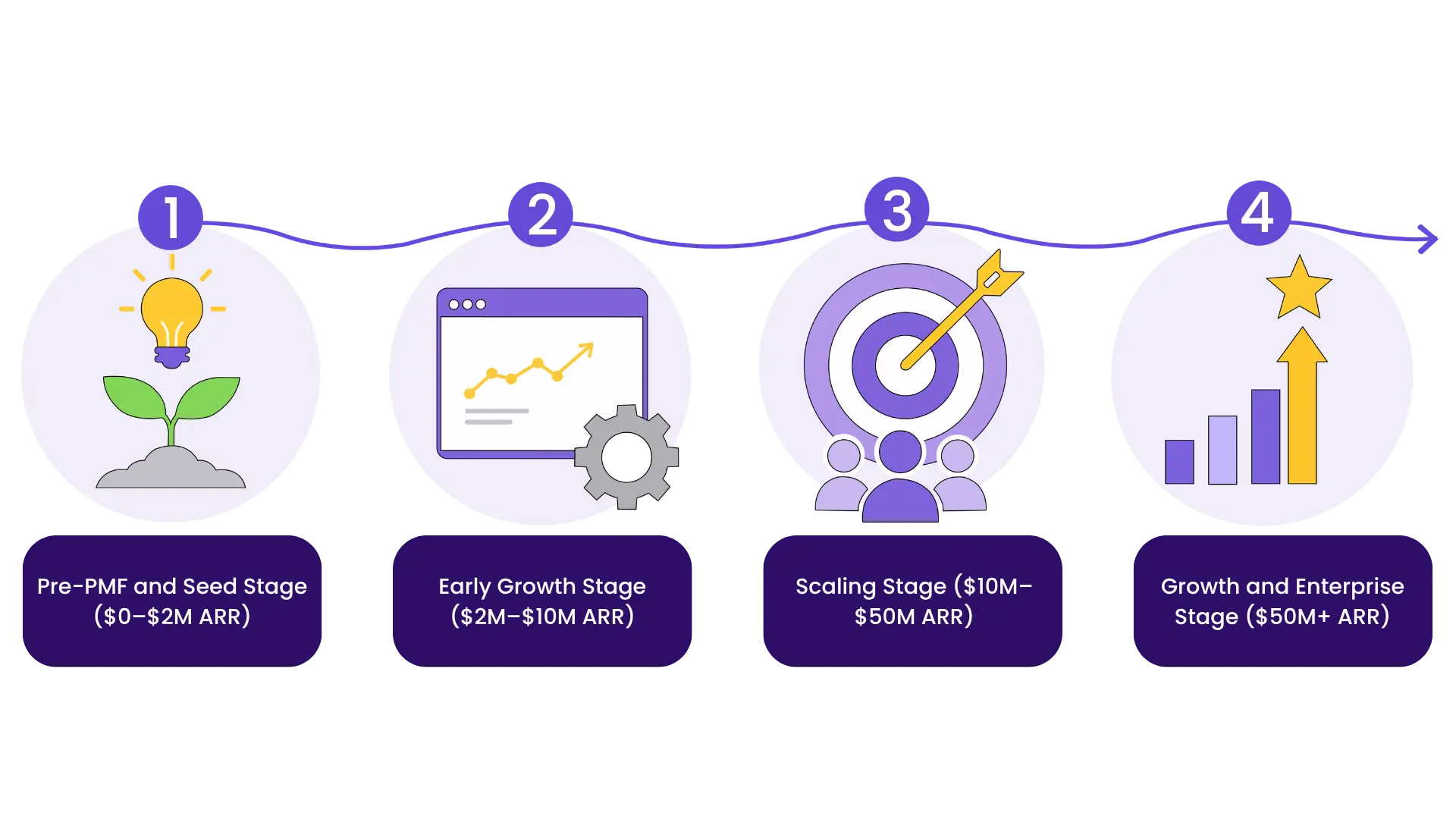
Stop thinking about this as agency versus in-house. Think about your stage.
Do not build in-house. You do not have the revenue to support a full SEO function and one wrong hire costs you both cash and runway.
Find an agency or specialist who understands early-stage SaaS and can help you identify which content and keywords map to your ICP.
One wrong hire here delays SEO progress by six months or more.
For most B2B SaaS companies with $1M to $50M in ARR, hiring a specialist agency is faster and more cost-effective than building in-house. At this stage you need momentum, not headcount.
An agency builds topical authority, fixes your technical foundation, and develops a backlink profile faster than any single hire.
Consider a fractional SEO strategist or Head of Marketing in-house to own the brief and stay aligned with the product.
Hybrid is the right model. Bring in a senior SEO or Head of SEO in-house to own strategy. Keep the agency for execution: link building, technical sprints, content production, and AI search optimisation.
Do not try to replace the agency entirely at this stage. The execution gap is real, and rebuilding that capability fully in-house takes time you likely do not have.
Build in-house if you are at $50M+ ARR with a real budget for senior talent, or if you have a strategic reason to own the function completely.
Even then, keep specialist agency support for link acquisition and technical SEO. Few in-house teams can sustainably run high-volume link building and GEO programmes simultaneously.
Revisit the model annually. This is not a one-time decision.
Whatever model you choose, ask this before you sign a contract or post a job description:
Does this team have a specific, credible strategy for AI search visibility in 2026?
AI-powered search: Google AI Overviews, ChatGPT search, Perplexity, Claude, now accounts for a meaningful share of the buyer research journey.
The SaaS SEO agencies worth hiring are already investing in generative engine optimisation and treating AI citation as a primary KPI. Agencies that ignore this are already falling behind.
The numbers make this concrete. The overlap between top-10 Google rankings and AI Overview citations has collapsed from 75% in mid-2025 to between 17% and 38% by early 2026, meaning high rankings no longer guarantee AI visibility.
Ranking well and being cited by AI are now two separate problems that require two separate strategies.
AI-referred traffic converts 4.4x better than standard organic search because visitors arrive already informed and further along in their buying decision. That is the channel your SEO partner, internal or external, needs to be actively building toward.
Any agency that cannot explain how they will get your brand cited in ChatGPT, Perplexity, Claude, and Gemini is selling you a 2022 playbook.
The same applies to any in-house hire who has not built a point of view on this yet. Use it as your filter question in every agency pitch and every hiring conversation.
SaaS SEO agency vs in-house SEO is not a permanent decision. It is a stage decision.
And most founders make it wrong because they only look at the salary line, or they confuse headcount for capability.
The agency wins on speed, specialist depth, and cost efficiency at early-to-mid stages. In-house wins when you have the ARR, the budget, the adjacent resources, and the patience to build it properly.
The hybrid model wins most of the time, for most SaaS companies, at most stages.
One more thing that is non-negotiable in 2026: whichever model you choose, it must have a clear strategy for AI-powered search. The marketers thriving in 2026 stopped optimising for rankings and traffic.
They optimize for trust, citation, and share of voice. Your SEO model needs to reflect that shift, or it is already behind.
Choose the model that fits where you are today, not where you want to be in two years. Then build from there.
If you want a second opinion on which model fits your current stage, the team at Digital SEO Land is happy to talk it through. No pitch, just a straight conversation.
Content is the foundation on which all marketing activities are based. And that is no different for the...
Read Case Study
AI Services





Link Building






Resources