
Link Building
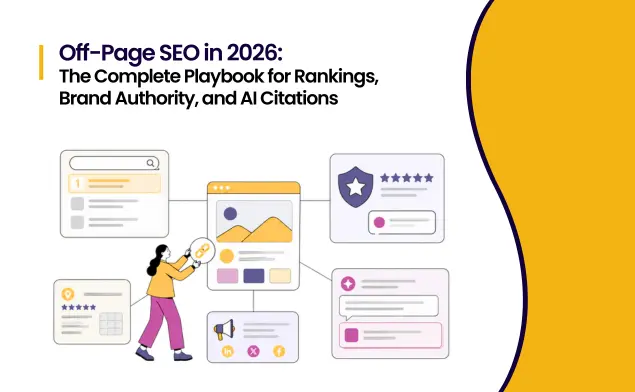


Backlinks alone no longer decide who wins in search. In 2026, roughly 91% of the information AI models cite comes from third-party sources, not your own website.
That single fact rewires how off page SEO works, what it costs, and what actually moves rankings and pipeline.
If you still think off-page is a backlink count, you are still playing an old game.
This guide walks you through
You will leave with a clear off page SEO strategy you can act on this quarter, whether you are a founder, a marketing manager, or an in-house SEO running a stretched team.
Off page SEO is everything you do outside your own website to build search visibility, authority, and trust.
That includes backlinks, brand mentions, reviews, community presence, PR coverage, and the signals that AI search engines now use to decide who to cite.
The old definition was narrow: backlinks, directory listings, and guest posts.
The 2026 definition is wider. It now covers
On the other hand, on-page SEO is what happens on your URLs: content, structure, internal links, technical health. Off page SEO, or off site seo, is what the rest of the internet says about you.
Both matter. In 2026, off-page carries more weight than ever because AI systems lean heavily on external signals to judge brand credibility.
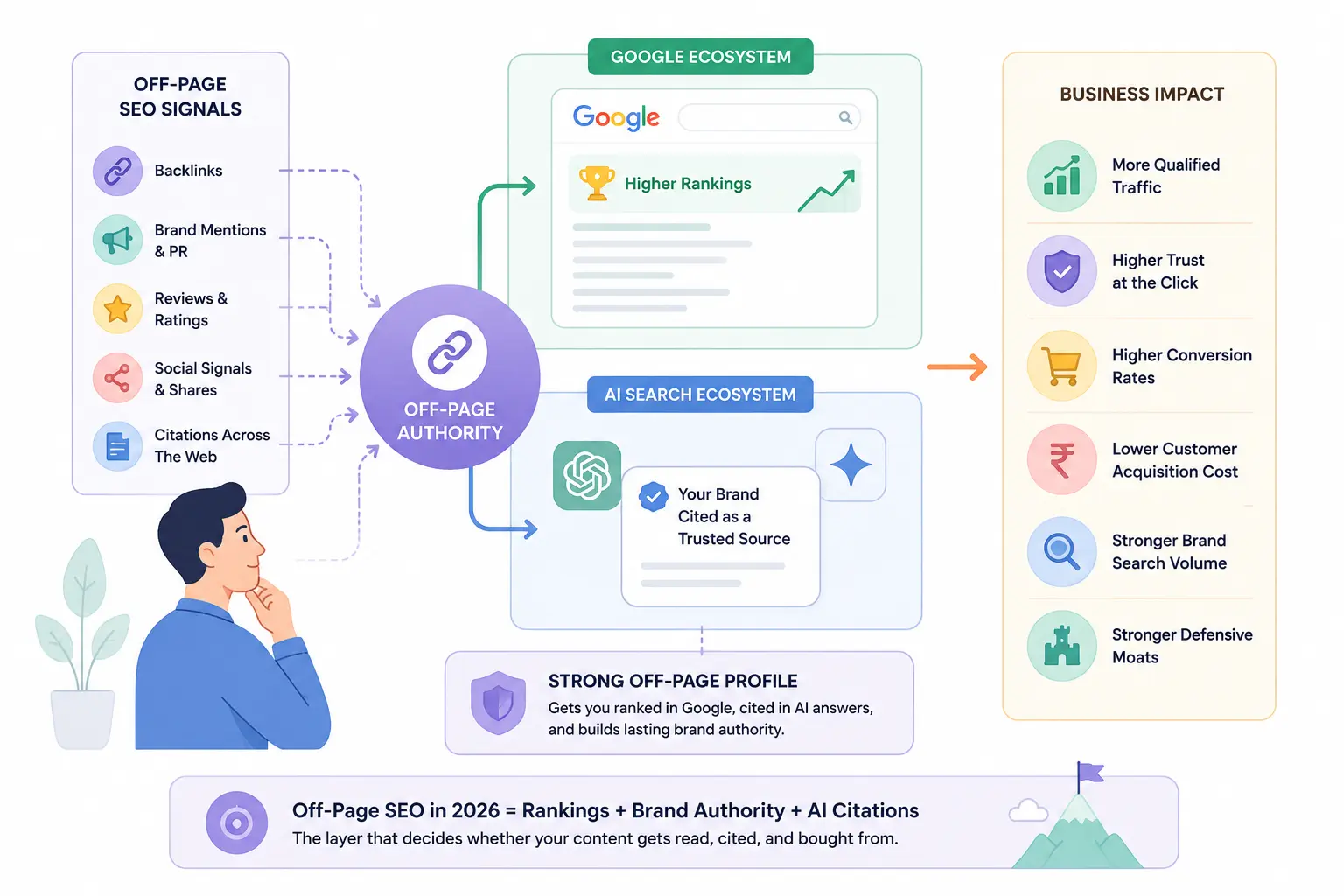
Off-page signals now feed two ecosystems at once.
Google still uses them for organic rankings. But AI search engines use them to decide which brands deserve a citation in an answer.
That double duty changes the math.
A single strong PR placement can lift you in Google AI Overviews, get you mentioned in ChatGPT responses, and earn a backlink the same week.
Whereas, a weak off-page profile drags you down in both at the same time.
The business case is straightforward. Strong off-page authority means more qualified traffic, better trust at the click, higher conversion rates, and lower customer acquisition cost over time.
Brand search volume, which is largely driven by off-site activity, has emerged as one of the top correlations with AI Overview visibility in recent studies.
The compounding effect is real.
Brands with consistent mentions, reviews, and citations across the web earn faster pickup on new content and stronger defensive moats against competitors.
For Indian businesses competing in crowded markets like SaaS, ecommerce, finance, and B2B services, this shift is especially sharp.
Off page SEO 2026 is the layer that decides whether your content gets read, cited, and bought from.
AI search did not kill off-page SEO. Instead it expanded it and made it one of the most important optimisation elements.
Four shifts now define how off page seo strategies need to work:
Unlinked brand mentions used to be a nice extra. They are now a core ranking and citation input.
Ahrefs data from late 2025 shows that off-site brand mentions and YouTube mentions correlate more strongly with AI brand visibility than raw backlink counts on many query types.
Brand web mentions and branded search volume are among the top drivers of AI Overview appearances.
If a tier-1 publication writes about you without linking, that mention still feeds your authority profile across Google and AI search.
Reddit, Quora, and niche forums now feed a huge share of AI citations.
Tinuiti’s Q1 2026 data shows Perplexity pulling around 31% of its January citations from social media, with Reddit alone near 24%.
ChatGPT favors Reddit, Wikipedia, and news. But Gemini barely touches Reddit at all.
That variance matters. The right community presence can put you inside ChatGPT and Perplexity answers your competitors cannot reach.
Google’s reported $60 million annual licensing deal with Reddit only reinforces this structural advantage.
Spray-and-pray guest posting is finished in serious markets.
Digital PR built on original data, surveys, and stories worth covering now drives both backlinks and AI citations.
Earned media syndication can lift AI citation visibility by 239% on a median basis, with some campaigns reaching 325%.
Journalistic and earned media account for roughly 25% of all LLM citations. That is too big a channel to ignore.
The old fear was a Google manual penalty for over-optimized anchors.
In 2026, the more common outcome is quiet devaluation. Google simply discounts the suspicious links, you waste budget, and you never get a notification.
White-hat execution still wins. The failure mode just changed shape.
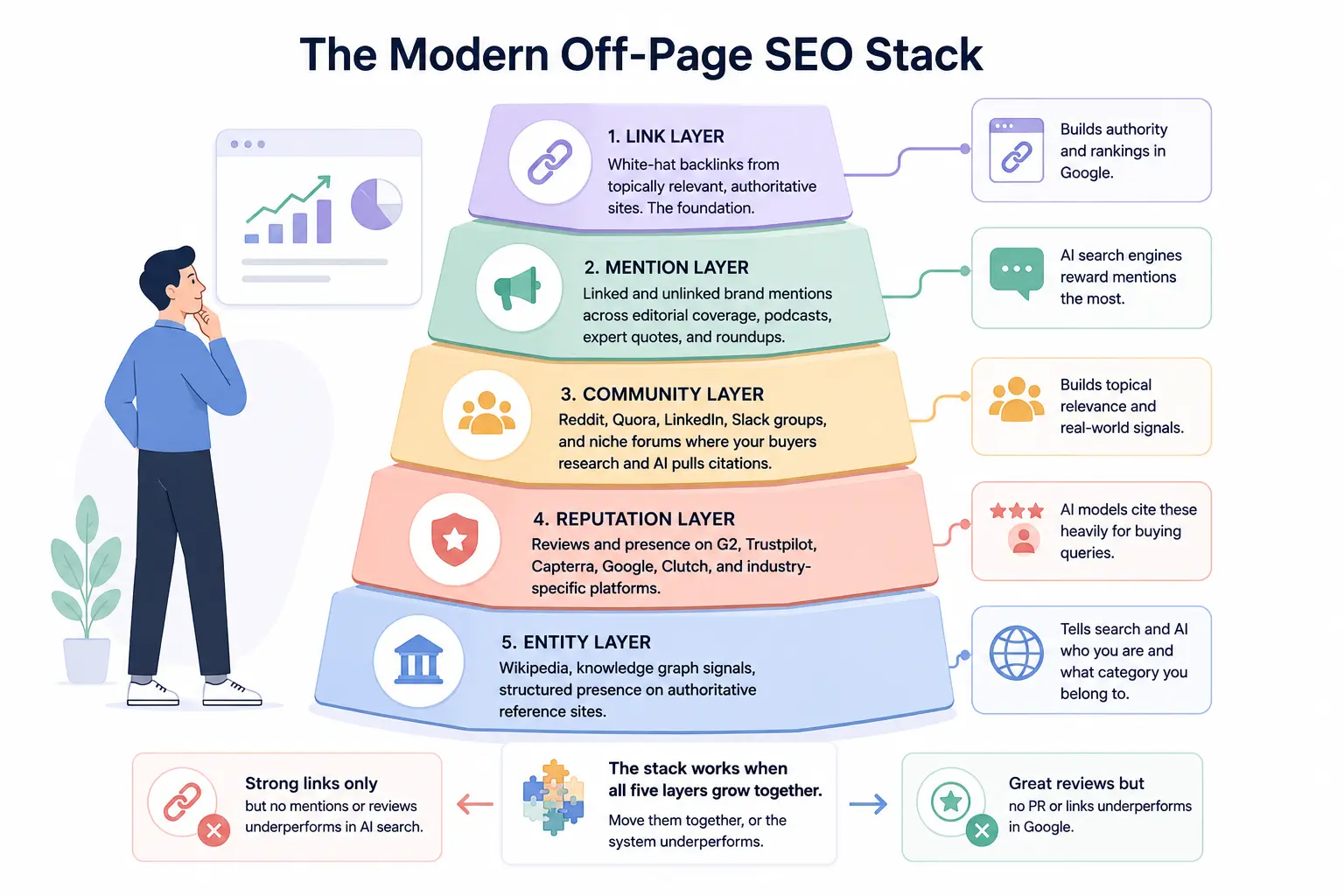
Most guides hand you a list of tactics. We think about off page seo as a connected stack of five layers. Each layer feeds the next. Move them together, or the system underperforms.
A site with strong links but no mentions or reviews underperforms in AI search. Whereas, a brand with great reviews but no PR or links underperforms in Google.
The stack works when all five layers grow together.
This is the framework we use when we audit and build off page seo strategy for clients. It keeps the work coordinated and the reporting honest.
These are the techniques that fill each layer of the stack. Pick the ones that match your stage and resources. Do them well, not all at once.
Topical relevance beats raw domain authority every time in 2026.
A link from a smaller, focused site in your niche moves the needle more than a generic placement from a high-DA general site.
Focus on editorial placements, resource page links, and clean niche edits. No PBNs, no link farms, no shortcuts.
Build campaigns around original data. Run a survey, mine your internal data for trends, commission a small study. Pitch journalists with a story, not a request.
Tier-1 placements earn backlinks, brand mentions, and AI citations from the same piece of work.
Plan one strong digital PR campaign per quarter rather than ten weak ones.
Get your brand named even when no link is included.
Pitch yourself as an expert source through HARO-style platforms, contribute to industry roundups, and accept podcast invitations.
A mention in a respected publication carries weight in AI search regardless of whether it links back. Track unlinked mentions monthly and convert the high-value ones into links when you can.
Show up as a real expert. Answer questions, share experience, link only when it genuinely helps the reader.
Communities detect and punish self-promotion fast, and astroturfing on Reddit is increasingly visible to moderators and to AI training filters.
Done well, this is one of the highest-leverage off page seo methods in 2026, especially if you want to increase AI visibility for your website.
YouTube mentions show strong correlation with AI visibility across ChatGPT, AI Mode, and AI Overviews. But it’s not necessary to run a channel.
Instead get featured on relevant channels, appear on podcasts that publish to YouTube, contribute to explainer videos, and earn product reviews.
Each video is a citation surface that AI models can read through transcripts.
G2, Trustpilot, Capterra, Clutch, and Google reviews are now core off-page assets.
Brands with strong third-party review presence see roughly 3x higher AI citation likelihood on buying-intent queries.
Build a steady review collection process. Respond to every review. Treat your G2 or Trustpilot profile as a landing page that AI models will read.
Wikipedia accounts for roughly 7.8% of ChatGPT citations and a meaningful share of LLM training data. You do not get to write your own Wikipedia page.
You earn one by being notable, then citation-worthy. Build the press coverage and category presence first. Wikipedia and similar reference sites follow.
For local businesses and Indian SMBs, Google Business Profile, local directory listings, and NAP consistency still matter a lot.
Maintain accurate listings on Justdial, Sulekha, IndiaMART, and category-specific Indian directories. Earn local press coverage where you can.
Local off page optimization remains one of the highest-ROI activities for service businesses across India.
LinkedIn dominates professional and B2B AI queries. Founder-led posts, employee advocacy, and consistent thought leadership build a citation surface that AI models index actively.
For B2B and SaaS brands, LinkedIn is now considered more as an off-page channel, not just a social channel. So treat it like one.
Short list. Read it twice.
Most off-page failure looks like one of these, not exotic algorithm changes.
The old metrics still matter. The new ones decide whether you stay visible in AI search.
Traditional metrics to keep tracking:
New 2026 metrics that belong in every report:
The tool categories worth investing in are AI visibility trackers(all in very early stages), brand monitoring platforms, and backlink analysis suites.
The exact tool matters less than reporting the right metrics together, monthly, with context.
If your current off page seo report only shows backlinks and rankings, you are flying with half a dashboard.
Use this as your quarterly working list.
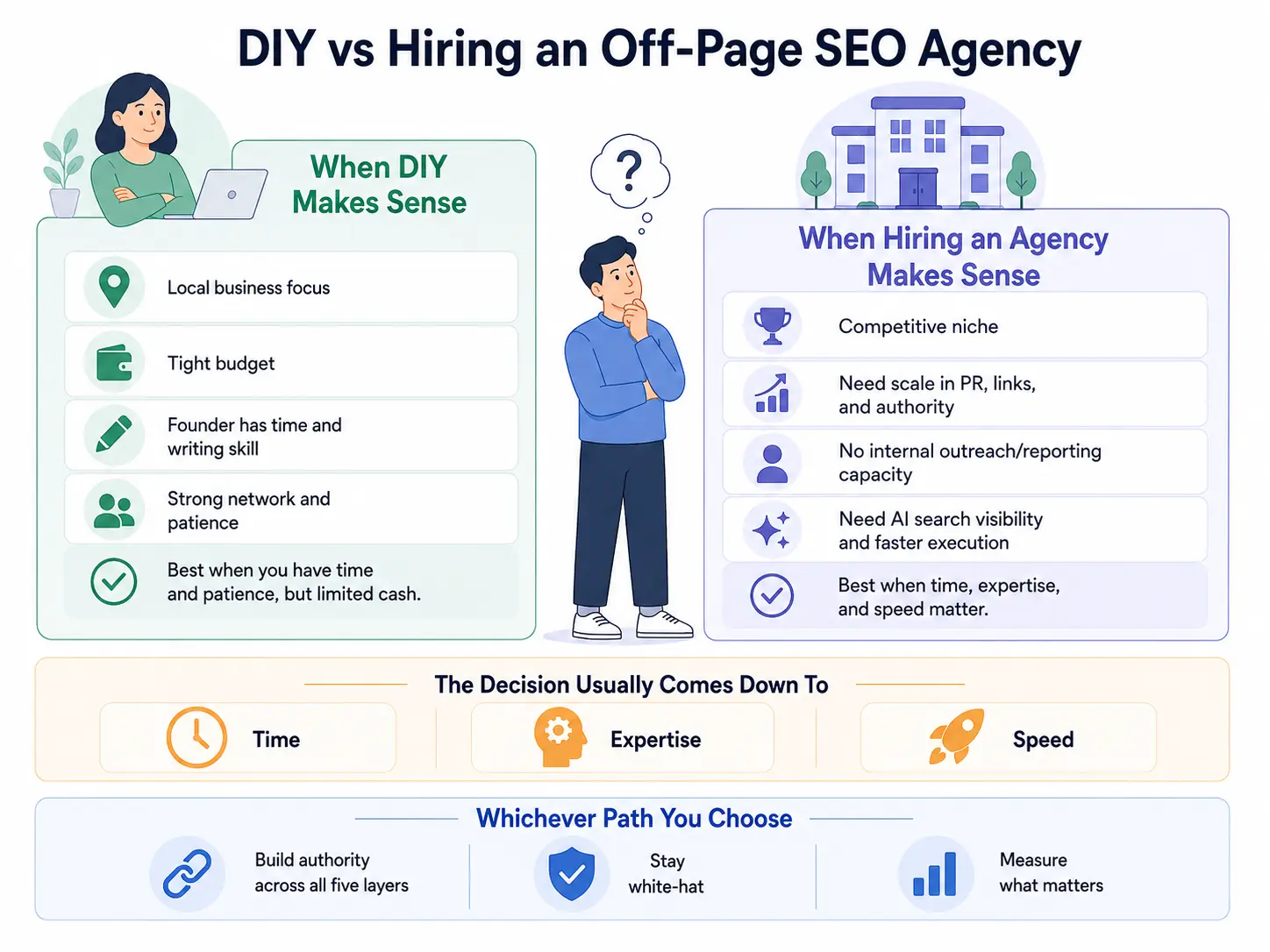
Honest section. Not every business needs an agency. But some absolutely do.
You are a small business with local focus and the founder has time, writing skill, and a network.
The budget is tight, the growth timeline can stretch, and you already have strong industry connections.
A founder who shows up consistently on LinkedIn, contributes to industry conversations, and earns occasional press can build meaningful off-page authority without outside help.
DIY works when you have time and patience but limited cash.
You operate in a competitive niche where digital PR, link building, and authority development need scale you cannot reach internally.
Good off-page work is execution-heavy. Outreach, content production, relationship building, PR pitching, review program management, and reporting add up to real hours every week.
The decision usually comes down to time, expertise, and how fast you need to move.
Whichever path you choose, the principles do not change. Build authority across all five layers of the stack. Stay white-hat. Measure what matters.
Off page SEO in 2026 is a system. It builds brand authority across Google and AI search at the same time, and it compounds when you treat it as ongoing work instead of a one-time campaign.
Backlinks still matter. But brand mentions, reviews, community presence, and AI citations matter just as much.
The brands that win this year are the ones building all five layers of the stack with patience and discipline. No shortcuts. No spammy networks. No hope that an algorithm change will save a weak profile.
Our approach at Digital SEO Land is transparent, white-hat, and built around real business outcomes.
If you want a clear picture of where your off-page profile stands today, request a free off-page SEO audit from our team. We will review your backlink profile, brand mentions, anchor health, and AI citation visibility, then share what to fix first.
Anchor text is the clickable text within a content with a link inside. It tells Google and AI systems what the linked page is about. Get it wrong and you waste link equity. Push it too hard and you get devalued.
Healthy 2026 anchor text distribution looks like this:
The Ahrefs study of 384,000 ranking pages found that top-ranking pages average near-zero exact-match anchor usage. That is not a typo. The pages winning in 2026 barely use exact-match anchors at all.
The risk profile also shifted. Google is less likely to hit you with a manual penalty for over-optimized anchors than it was five years ago. The dominant response now is silent devaluation. Your links exist, Google just stops counting them. You never get a notification, you just notice growth stalling.
Practical rule: audit your anchor profile quarterly. If exact-match creeps above 5 percent, slow down and rebalance. Branded anchors should always dominate.
Yes, more important than ever. The definition just expanded beyond backlinks to include brand mentions, AI citations, reviews, and community signals. Sites with weak off-page profiles now lose in both Google and AI search.
On-page SEO is everything you do on your own website: content, structure, internal links, technical health. Off page SEO is everything that happens off your website: backlinks, mentions, reviews, citations, PR, and community presence.
Early signals usually appear in 3 to 6 months. Compounding impact on rankings, traffic, and AI citations typically shows in 6 to 12 months. Authority builds slowly and lasts.
No. Backlinks still matter as a strong ranking signal. They simply no longer carry the full load alone. Brand mentions, AI citations, and reviews now sit alongside them as core off-page inputs.
You can build meaningful brand authority through mentions, reviews, podcast appearances, and community presence. But high-quality backlinks remain one of the strongest single signals in both Google and AI search. The smart play is to do both.
Brand authority, expressed through the combination of links, unlinked mentions, citations, reviews, and community presence. No single signal wins. The brands gaining ground are the ones moving all five layers of the off-page stack together.
After helping numerous ecommerce brands scale their visibility and sales, I can confidently say one thing: a great...
Read Case Study
Imagine you are running a race, but you cannot see where you are going or who else is...
Read Case Study
With Connectively (formerly HARO – Help a Reporter Out) closing its doors on December 9, 2024, PR professionals...
Read Case Study
AI Services


Link Building


Resources