Casino SEO


Search for almost any competitive casino keyword on Google right now.
Look at the websites on page one.
They are not necessarily the most generous. Not always the best designed. Some have been around for years without doing anything particularly remarkable with their product.
But they have one thing in common: Google trusts them.
That trust wasn’t accidental. It was built, deliberately, through SEO strategies that go well beyond keywords and backlinks.
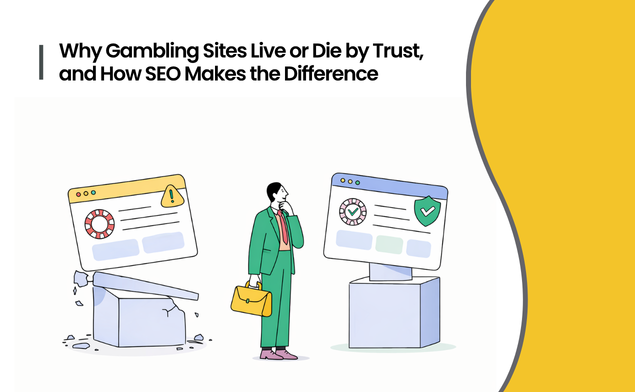
And in a niche as scrutinised as online gambling, building that trust is the whole game.
Here’s why it’s harder in this vertical than almost anywhere else. How gambling sites build trust using SEO isn’t a straightforward question with a simple answer.
Gambling sits inside Google’s YMYL classification, which means every page on your site is being evaluated not just for relevance, but for legitimacy.
The algorithm, and the real human quality raters behind it, want to know:
Is this site safe for users?
Is it honest?
Does it actually know what it’s talking about?
Get those answers right across your website, and rankings follow. Get them wrong, and no amount of optimization will save you.
This is the exact playbook top operators use to rank consistently.

Google classifies gambling content under a category called YMYL: Your Money or Your Life. It covers any content that could directly affect a person’s financial well-being, health, or safety.
Online casinos sit squarely in this category because your users are making real financial decisions, often involving risk, on your platform.
What this means in practice is that Google holds gambling sites to a higher standard than it holds most of the web.
Your casino website falls under Google’s YMYL classification because it involves financial transactions and risk, and Google’s quality raters manually evaluate gambling sites for trust signals, expert content, and transparent business practices.
These are not automated checks alone. Real people assess whether your site looks legitimate, transparent, and safe.
The consequence of failing that assessment is severe.
Sites failing E-E-A-T requirements don’t just rank poorly; they risk manual penalties or complete de-indexing.
The market context makes this even more important to get right.
The global online gambling market stands at USD 121.63 billion as of 2025. That scale brings intense competition, and it brings Google’s scrutiny with it.
Online casino SEO and sports betting SEO have become Google’s most restricted verticals, with CPCs exceeding $55 for competitive keywords.
Paid advertising is either restricted outright or prohibitively expensive. For most operators, organic search isn’t just a growth channel; it’s the primary one.
That’s the environment you’re operating in. Here’s how to build the trust required to compete.
Most operators think of their gambling licence as a legal necessity. The smarter ones treat it as an SEO asset.
Crucial trust signals in the iGaming category include visible and valid gambling licences, contact data and transparent ownership, precise bonus terms and fair game instructions, and player protection facilities and responsible gambling data.
These aren’t just good practices for user experience. They are the specific signals Google’s quality raters are looking for when they evaluate your site.
There’s a backlink dimension to this, too.
Being listed and linked on a trusted regulatory body’s website, such as the UK Gambling Commission, signals to both users and search engines that your casino operates legally and ethically, and can improve your ranking while instilling confidence in your audience.
A link from a regulatory body carries a weight that almost no other source in your niche can match.
The operators who understand this stop seeing compliance as overhead and start treating it as a competitive advantage.
Online gambling businesses perform best when they treat UKGC, MGA, and Curaçao guidelines as frameworks for building trust. By focusing on player protections, companies turn compliance into a brand advantage.
The practical checklist here is straightforward: display your licence number prominently, make your ownership and contact information easy to find, write your bonus terms in plain language, and ensure your T&Cs and privacy policy pages are accessible from every part of the site.
If your site lacks proper disclaimers, responsible gambling information, or secure transaction protocols, it will struggle to rank regardless of your backlink profile.
Compliance sets the floor. What you build above it is what separates ranking sites from the rest.
Responsible gambling sections are one of the most underestimated SEO tools in an operator’s arsenal.
Pages covering age restrictions, self-exclusion options, bankroll management guidance, and links to support organisations like GamCare or BeGambleAware are not just regulatory requirements.
Responsible content for the iGaming site is not only about compliance checking but also serves as a crucial trust signal for SEO.
Google’s quality raters are specifically instructed to check whether gambling sites provide this kind of protective content.
A well-built, responsible gambling section tells both the regulator and the algorithm the same thing: this site is operated by people who understand and respect what’s at stake for their users.

E-E-A-T stands for Experience, Expertise, Authoritativeness, and Trustworthiness. It’s the framework Google uses to assess content quality, and for gambling content, E-E-A-T signals carry more weight in ranking decisions than they do for most other content categories.
Here’s what each component actually requires from a gambling site.
The first E in E-E-A-T is for experience, and it’s the one most operators overlook.
Google rewards content that reflects first-hand use or testing, so including real screenshots of gameplay and step-by-step walkthroughs of various games is advisable.
This isn’t about manufacturing authenticity. It’s about documenting real testing.
A casino review written by someone who has actually deposited, played, and withdrawn reads differently from one assembled from a game provider’s press kit.
Google’s algorithms, and your readers, can tell the difference.
Generic author names like “Casino Team” or “Editorial Staff” are a red flag in this vertical.
Publishing under real author bylines with verifiable credentials, including first-person experience signals, and citing primary sources such as regulatory filings and earnings reports is essential.
Author pages are non-negotiable for casino content.
Each author should have a dedicated biography page that includes their professional background, relevant certifications or industry experience, social media profiles, and links to their published work.
Person schema markup on author pages reinforces these signals to Google’s algorithms.
You cannot declare yourself authoritative. It has to be conferred.
Earning mentions and links from reputable sources in the gambling industry and mainstream media is how authoritativeness is built.
Awards, independent reviews, and industry recognition all contribute. The more credible third-party voices point to your site as a trusted resource, the stronger this signal becomes.
Displaying clear contact information, transparent terms and conditions, and prominent responsible gambling messaging are the core components of trustworthiness.
Add HTTPS encryption and visible security certifications. Make sure your site looks and behaves like a business that has nothing to hide.
If it doesn’t, no volume of backlinks will compensate.
Ranking for competitive gambling keywords without topical authority is like trying to win a poker hand without a full table.
The mechanics might work, but the foundation isn’t there.
Topical authority means covering your subject comprehensively enough that Google recognises your site as a genuine resource on that topic, not just a page that mentions the right keywords.
The most effective way to build this in the gambling vertical is through the pillar-cluster content model.
Pick a core topic, say, blackjack. Build a pillar page that covers it thoroughly.
Then build cluster content around it: basic strategy guides, rule variations between European and American versions, RTP breakdowns, bankroll management for blackjack players.
Every cluster page links back to the pillar, and the pillar links out to the clusters.
This structure signals topical authority to Google.
Repeat this across your key game and betting categories, and you stop being a site with some gambling content. You become a genuine reference in the space.
Most marketers focus almost exclusively on transactional pages: “best online casino UK,” “sign up bonus slots,” “deposit now.”
These pages matter, but they can’t do the job alone.
Informational keywords are important for creating trust, signalling authority, and educating users, while money keywords are for converting high-intent traffic.
Both should be connected through clear user journeys and efficient internal linking.
Think of a guide explaining how online casino RNG works.
It doesn’t convert directly.
But it builds credibility with the reader and signals genuine expertise to Google. That same reader, now educated and trusting, is far more likely to convert on your slots page than someone who landed cold on a bonus offer.
Content also needs to be maintained.
Bonus pages, regulatory guides, comparison pages, and game reviews go stale fast. Regular updates signal to Google that your site is actively managed and reliably current.

There’s no point softening this. Link building for gambling sites is harder, more expensive, and more restricted than in almost any other vertical.
In the SaaS industry, an SEO and link-building budget of $10–15k per month can get you to the top spots in Google. But in the gambling niche, you’re looking at $40–50k per month to get similar results.
Publishers are cautious. Regulations limit options in many markets. And Google watches this niche more closely than most.
Ahrefs data shows that websites with strong backlink profiles generate 55% more organic traffic compared to those without.
The key principle is quality and relevance over volume.
Link authority from gambling-relevant domains carries more weight than links from general domains at equivalent metrics.
A contextual link from an established casino review site or sports betting publication moves rankings more than a link from a general directory at the same score.
The most reliable sources of genuine authority links in this vertical include editorial placements on gambling news sites and iGaming publications, guest posts on relevant sports or casino blogs, mentions in mainstream entertainment or sports coverage, and being cited or listed by regulatory bodies.
There’s also a category that many operators miss: genuinely useful tools.
Earning mentions or backlinks from respected gambling publications or forums can help demonstrate authority, as can providing unique tools or databases such as RTP calculators and bonus trackers.
Build something that industry writers and players actually want to reference, and the links follow naturally.
One more consideration worth noting:
Search models like ChatGPT, Gemini, and Grok rely on trusted signals such as links and brand mentions to surface authoritative content.
Building genuine authority through SEO is no longer just a Google strategy. It positions your brand across the entire evolving search landscape.
Spammy forum links, private blog networks, expired domain manipulation, and paid do-follow links are all short-term plays in a vertical where Google is watching most carefully.
Google’s spam policies explicitly target manipulative link practices, and gambling is a regulated category where backlink strategy has to be cleaner and more risk-aware than in lower-risk niches.
Getting penalised in this vertical isn’t just a rankings setback. It can take months to recover, if recovery comes at all.
A player decides whether to trust your site before they read your first heading.
Page speed, mobile experience, and site security all form an instant impression.
In a vertical where users are handing over payment details, that impression carries real weight.
HTTPS encryption is crucial for protecting user data and building trust. Search engines prioritise secure sites in their rankings, considering them more trustworthy and safer for users.
This is a baseline requirement, not a differentiator.
Page speed matters more here than in most industries.
A slow casino site doesn’t just frustrate users. It signals instability and unreliability to people who are deciding whether to deposit real money.
Core Web Vitals should be treated as a trust audit, not just a technical checklist.
On mobile, the stakes are even higher. With 73% of gambling happening on mobile devices, mobile optimisation has evolved beyond responsive design.
Your mobile experience needs to be as smooth and trustworthy as your desktop version, including fast load times, intuitive navigation, and secure payment flows.
Schema markup adds another layer of visibility and trust.
Structured data for reviews, ratings, game information, and FAQs helps Google understand and accurately represent your content in search results.
For gaming operators serving multiple markets, hreflang tags ensure the right regional content reaches the right audience, which signals both compliance and relevance simultaneously.

Here’s the commercial case for everything above.
Players who find a site through Google’s organic results convert 3 to 5 times better than those from paid ads. Because they already trust the brand enough to type the query themselves.
The act of searching, finding, and choosing your site through organic results is itself a trust journey.
By the time that player lands on your page, they have already done their own vetting.
That’s what makes SEO-driven trust-building worth the investment.
It is not a separate job from player acquisition. It is player acquisition, just with a longer build time and a significantly higher return per player.
The sites that consistently win at how gambling sites build trust using SEO are not the ones with the biggest short-term budgets. They are the ones that have built compliance, authority, expert content, and clean link profiles into the foundation of their digital presence.
That kind of trust compounds.
Every piece of quality content, every authoritative backlink, every well-built author page adds to a body of evidence that tells Google: this site belongs at the top.
Shortcuts, in a vertical this scrutinised, don’t just fail. They set you back.
Build Trust First. Rankings Follow.
Trust is not a feature for gambling sites. It is the entire product.
Google’s job is to protect its users, and in a category involving real money and real risk, it takes that job seriously.
Every strategy covered here, from licence visibility to E-E-A-T content, topical authority, quality link building, and technical hygiene, serves the same purpose:
making your legitimacy undeniable, to the algorithm and to the player.
Get the trust infrastructure right, and the rankings become a natural consequence.
If you’re looking to build an SEO strategy for your gambling or casino site that’s grounded in long-term authority rather than short-term tactics, Digital SEO Land can help.
Get in touch with our casino SEO team for a consultation.

AI Services





Link Building






Resources