SEO
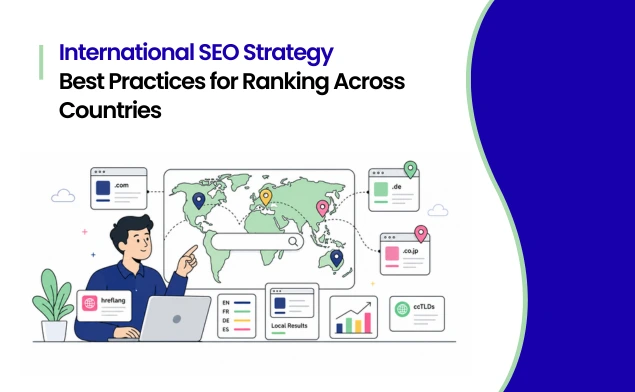


An international SEO strategy is the structured process of optimizing your website so search engines can identify which countries and languages you target, then serve the right version of your content to the right users.
It combines site architecture, technical signals, localized content, and regional authority building to drive organic visibility across multiple markets.
Most businesses think international SEO starts with translation. It does not.
It starts with a structural decision you cannot easily reverse. Get that wrong, and every page you publish, every link you earn, and every keyword you target ends up working against you. Get it right, and you build a compounding organic presence across markets that your competitors cannot quickly replicate.
70% of global search queries are non-English, and multilingual SEO unlocks traffic opportunities outside English-speaking markets. If your site exists only in English, you are invisible to the majority of the world’s searchers.
This guide covers every layer of a working international SEO strategy: URL structure, hreflang implementation, market-level keyword research, genuine localization, local authority building, technical performance, and how to measure results per market. Whether you are a growing e-commerce brand seeing unexpected traffic from Germany or a SaaS company planning a deliberate global expansion, the principles here apply.

This is the most consequential decision in any international SEO strategy. Change your mind halfway through, and you are looking at a full site migration with real ranking risk.
You have three options.
Country-code top-level domains (ccTLDs) like .de or .fr are the strongest geo-targeting signal but the most complex to manage. They offer strong local trust and are useful where users expect a local domain. The downside is significant: ccTLDs split domain authority across separate properties, require independent link building for each, and carry a higher operational cost.
Amazon uses this model (amazon.co.uk, amazon.de, amazon.in), but they have the infrastructure to support fully independent market presences. Most businesses do not.
Subdirectories are often the best starting point for most businesses. They consolidate all authority on a single domain, are easier to manage technically, and allow scaling without registering new domains. One CMS, one hosting setup, unified analytics.
Adobe uses this approach (adobe.com/fr/, adobe.com/de/), allowing the company to consolidate SEO benefits under one strong global domain. Zara’s implementation of subdirectories and hreflang resulted in approximately 19.13 million in monthly traffic value by 2025. For most businesses, subdirectories are the right default.
Subdirectories (/de/, /fr/) are easier and consolidate authority, while subdomains (de., fr.) offer a middle ground. In practice, subdomains are treated more like separate sites by Google and do not automatically inherit root domain link equity. They are not the recommended option unless your technical setup genuinely requires it.
The short answer: Start with subdirectories. Move to ccTLDs only when you have a mature market presence, a dedicated local team, and a genuine need for brand or legal separation.
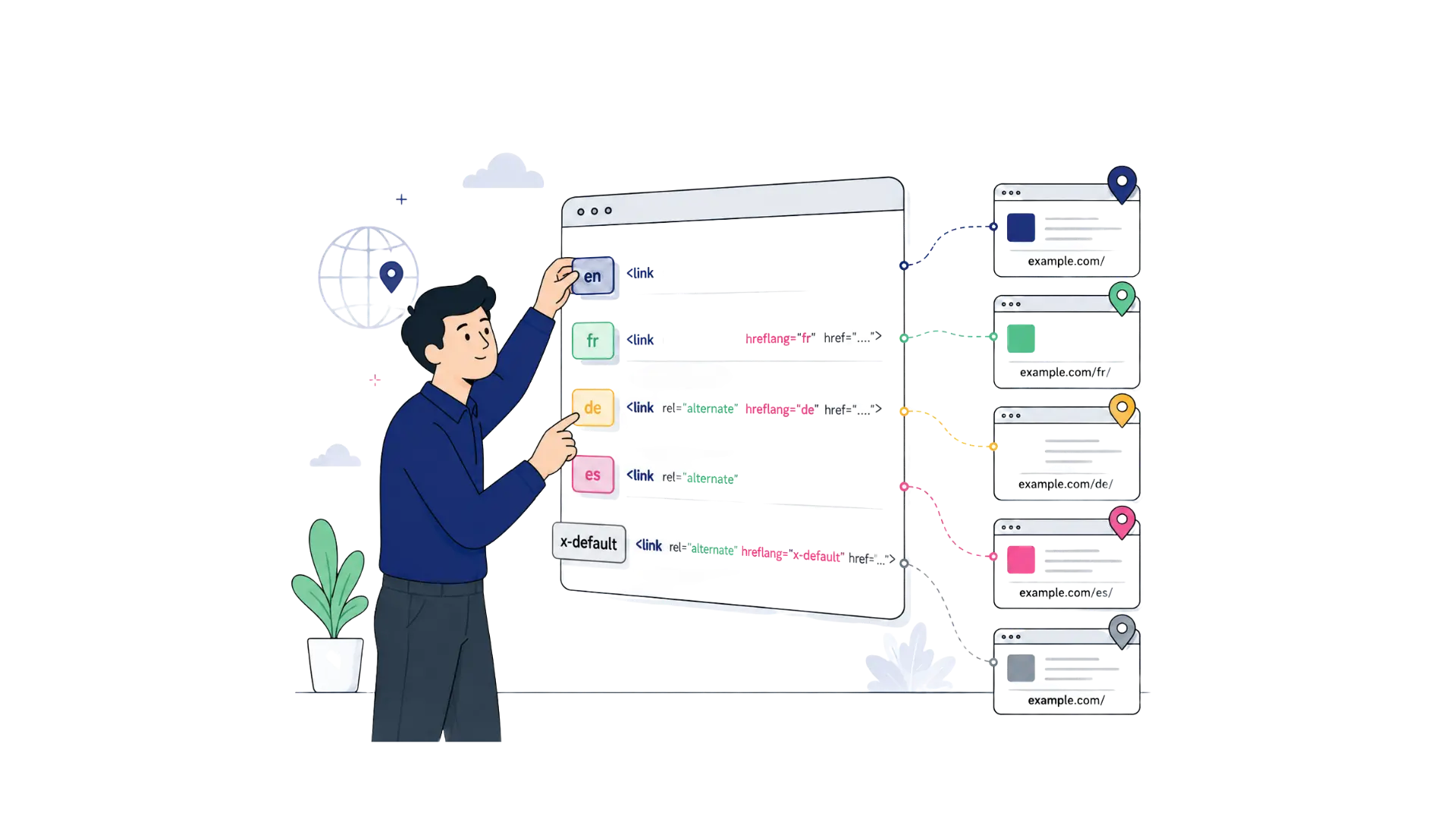
The hreflang attribute is the single most important technical signal for international SEO. It tells Google which version of a page to show to users based on their language and location, preventing duplicate content issues and ensuring the right audience sees the right content.
The problem: most businesses get it wrong. An Ahrefs study found that 67% of websites have issues with their hreflang tags. A single error in an hreflang cluster causes Google to ignore the entire cluster, wasting your implementation effort entirely.
Hreflang is not a one-time setup. This commonly happens during site migrations or URL structure changes when old URLs are redirected, but hreflang annotations are not updated simultaneously.
A further issue arises when hreflang tags contradict the canonical tags, noindex tags, or link to non-200 URLs. For example, on an English page for a US audience, the hreflang tag might reference itself and the English UK page, but the canonical tag points to the English UK page instead of itself. This creates conflicting signals that search engines struggle to resolve.
Also, avoid forced geo-redirects. If users from Germany cannot access your US site, Googlebot cannot either, which blocks indexation of alternate locale pages. Use a locale-suggestion banner instead.
Audit regularly using Google Search Console’s International Targeting report, Screaming Frog, or Semrush Site Audit.
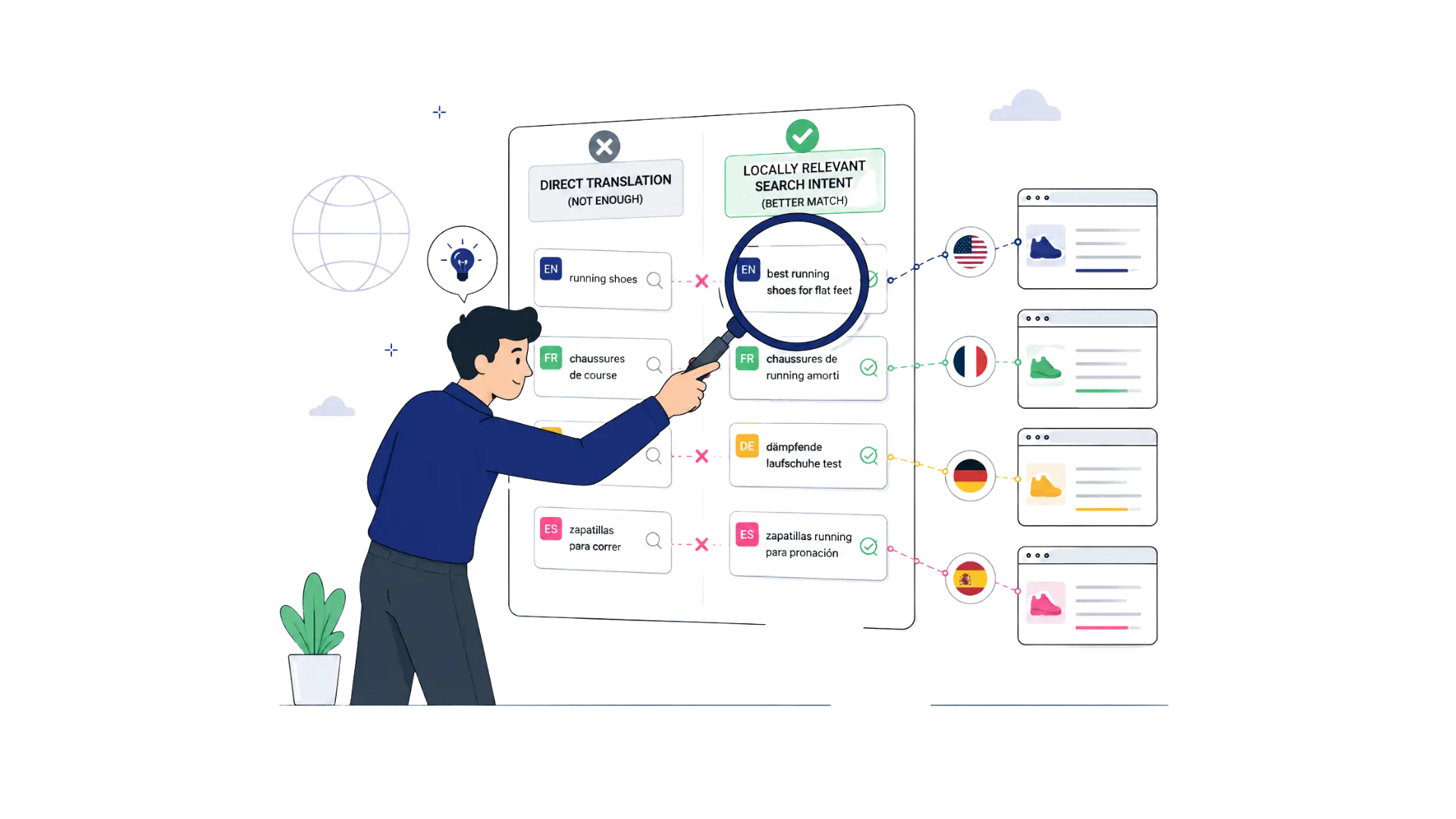
This is where most international SEO campaigns quietly fail. Teams take their best-performing domestic keywords, run them through a translation tool, and map them to new locale pages. It rarely works.
Businesses assume that translating high-performing keywords from their primary market will unlock success in new ones. But this approach almost never works.
People do not express needs the same way across languages or cultures. Search behavior shifts based on market maturity, device preference, and local competitors. Even within the same language, terminology and user expectations vary dramatically.
A basic example: a US audience searches “sneakers.” A UK audience searches “trainers.” Same product, completely different terms. A campaign optimized only for “sneakers” misses qualified traffic in every other English-speaking market.
Localized content performs 6x better than translated content, based on a study by the Nieman Journalism Lab. The gap between translation and true localization shows up directly in rankings and conversions.
Just because a keyword has volume in English does not mean the translated version does. In some countries, users search for the English term, in others, such as France, they might use “Logiciel” instead of “Software.”
Lower-volume local-language keywords can also outperform their English equivalents in conversion rate. Smaller search volume, less competition, and users with higher local purchase intent. Always research the target market natively before assuming English terms will carry over.
Websites with translated metadata see a 13% increase in click-through rates from international SERPs, according to Weglot data. Even small, precise changes at the keyword and metadata level produce measurable results.

Translation changes the words. Localization changes the experience.
Directly translating your content is not enough. True success comes from localization, adapting your website’s language, imagery, currency, date formats, and cultural references to resonate with a local audience. This requires human expertise, not just machine translation.
Google’s quality systems detect the difference. Unreviewed machine translation outputs content that can trigger thin content signals, which affects rankings across all language versions of your site, not just the translated page.
Genuine localization goes well beyond word-swapping:
75% of users prefer to buy products in their native language, according to CSA Research data. That preference does not stop at the product page. It extends to every touchpoint: navigation, error messages, checkout copy, and email confirmation.
Professional translation becomes essential for complex, technical, or legally sensitive content where accuracy is critical. Medical, legal, financial, and technical content requires certified translators with subject matter expertise.
Even for standard content, human review is non-negotiable. Even strong AI translation tools require an editorial pass for cultural accuracy, tone, and intent. A machine cannot know that a phrase is colloquially offensive in one region or that a CTA reads as aggressive in another culture.
Prioritize your most commercially important pages first: product pages, service pages, and main landing pages. Fifty excellent, fully localized pages are better than five hundred mediocre ones.
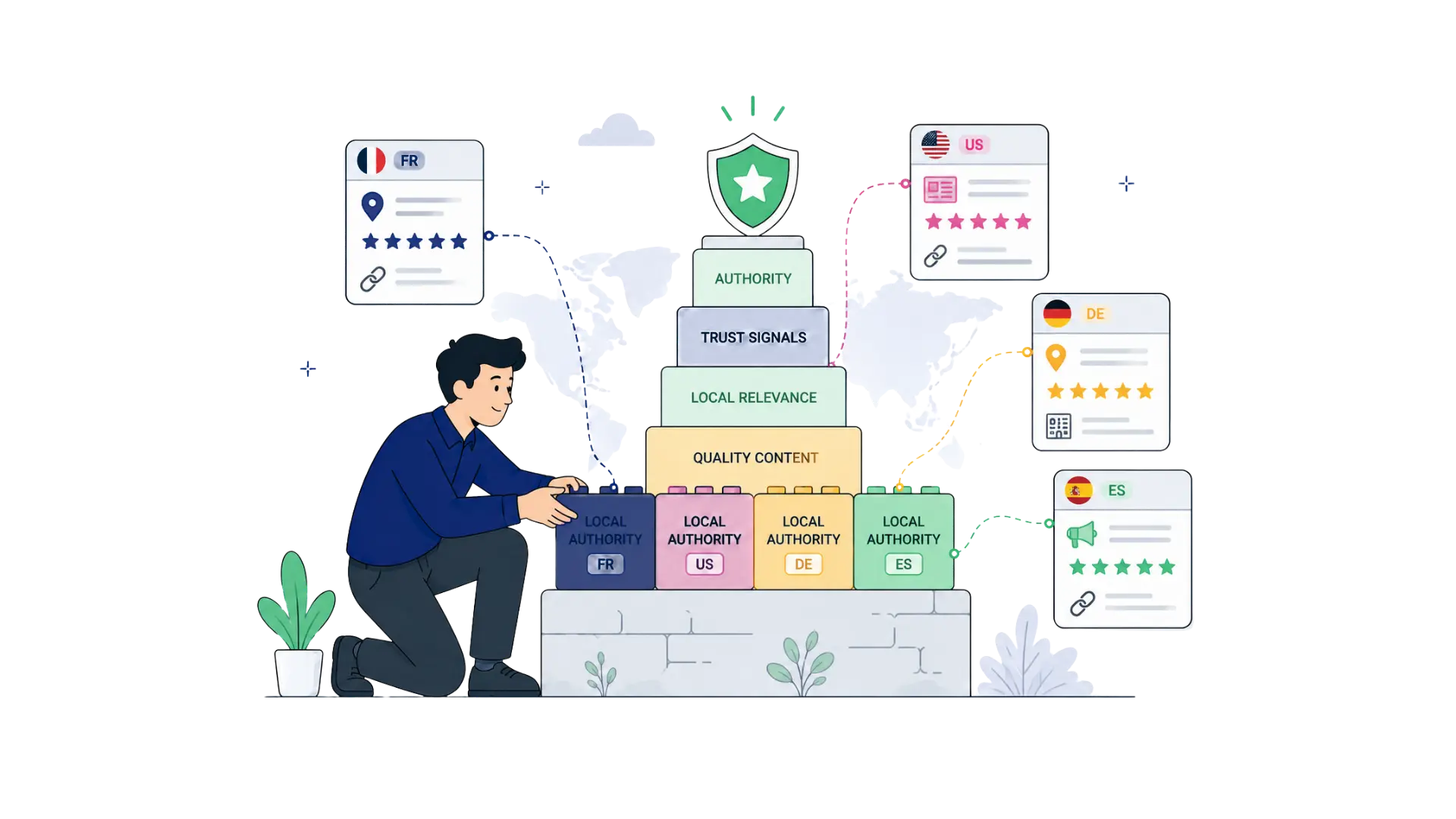
Your global backlink profile does not travel with you into a new market.
Your link-building and promotion efforts must be tailored to each target market. Earning backlinks from locally respected and relevant websites in Germany is far more valuable for ranking in Germany than earning links from US-based sites.
Each market has its own trust ecosystem. A high-authority US publication may carry no local weight in Japan. A modest but trusted regional trade magazine in that market matters far more to a Japanese search result than a Forbes feature.
Lead with value using exclusive data, localized insights, and expert quotes. Maintain relationships even when you are not actively seeking coverage. Micro-influencers often provide better ROI than macro-influencers in both B2B and B2C contexts, especially in smaller markets where industry communities are tight-knit.
In practical terms, this means:
International authority takes time. Plan for 6 to 12 months before meaningful results appear in a new market. Start with one or two priority markets rather than spreading thin across many simultaneously. Treat each market as its own SEO project with its own timeline, resources, and measurement framework.
When you need an international SEO company or international SEO agency to support this process, look specifically for teams with demonstrated in-market experience, not generalist agencies promising global coverage from a single location.
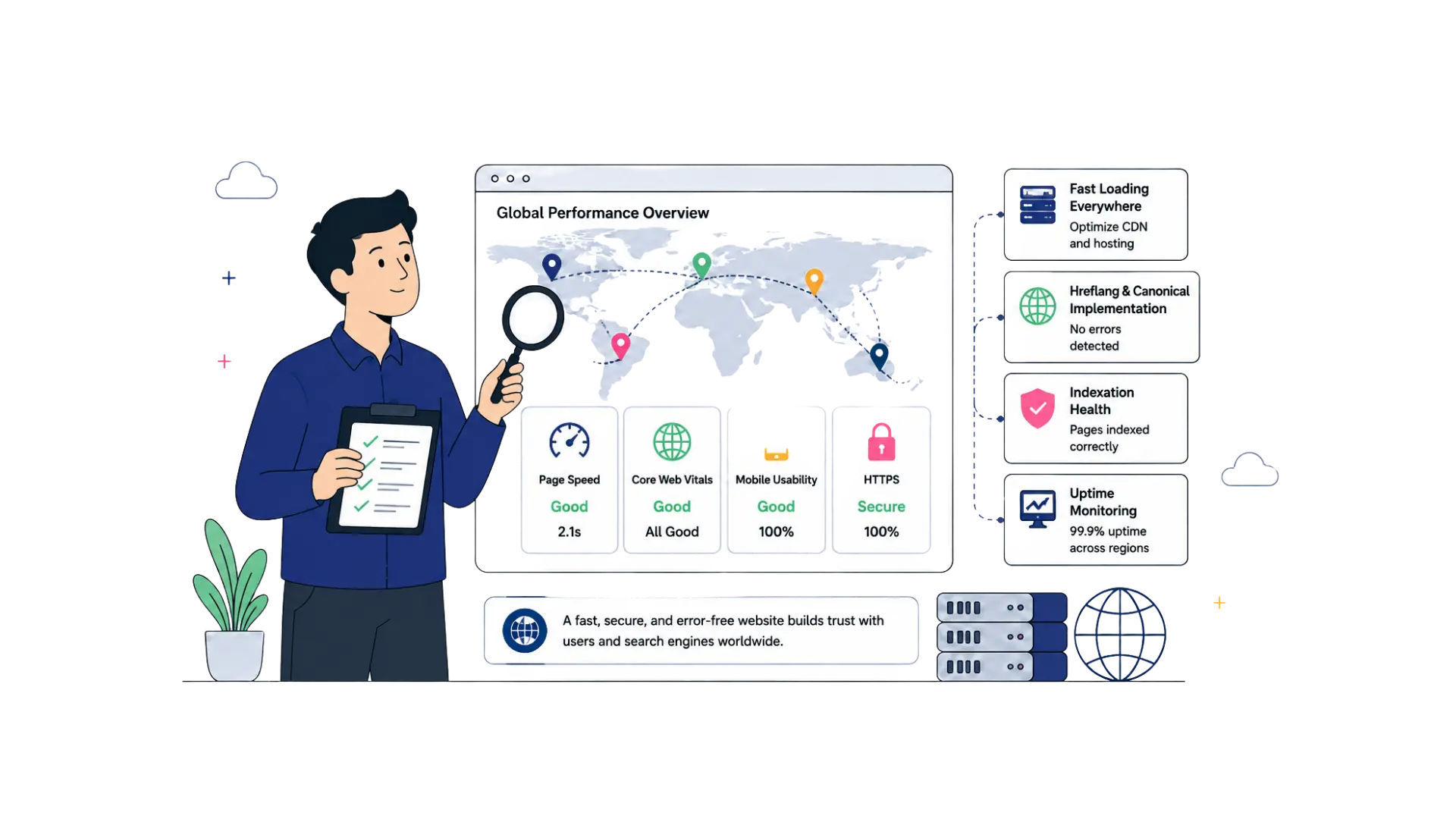
A slow website is a major barrier to global success. Use a Content Delivery Network (CDN) and choose a hosting solution that provides excellent performance worldwide.
Core Web Vitals are a ranking factor globally, and performance differences across geographies are measurable and real. A page loading in 1.7 seconds in Germany may load at 2.6 seconds in Brazil if your hosting infrastructure is European-centric. That gap directly affects your CrUX scores and your local rankings.
Mobile accounts for over 62% of global web traffic and 77% of retail visits. In emerging markets, especially, mobile is often the only screen. Mobile-first design is not optional for international SEO. A desktop-optimized experience in a mobile-dominant market will lose rankings and users regardless of how good your content is.
A CDN distributes your content across geographically dispersed servers, so users in every target market receive pages from a node close to them. For international sites, this is not an optional technical upgrade. It is a baseline requirement.
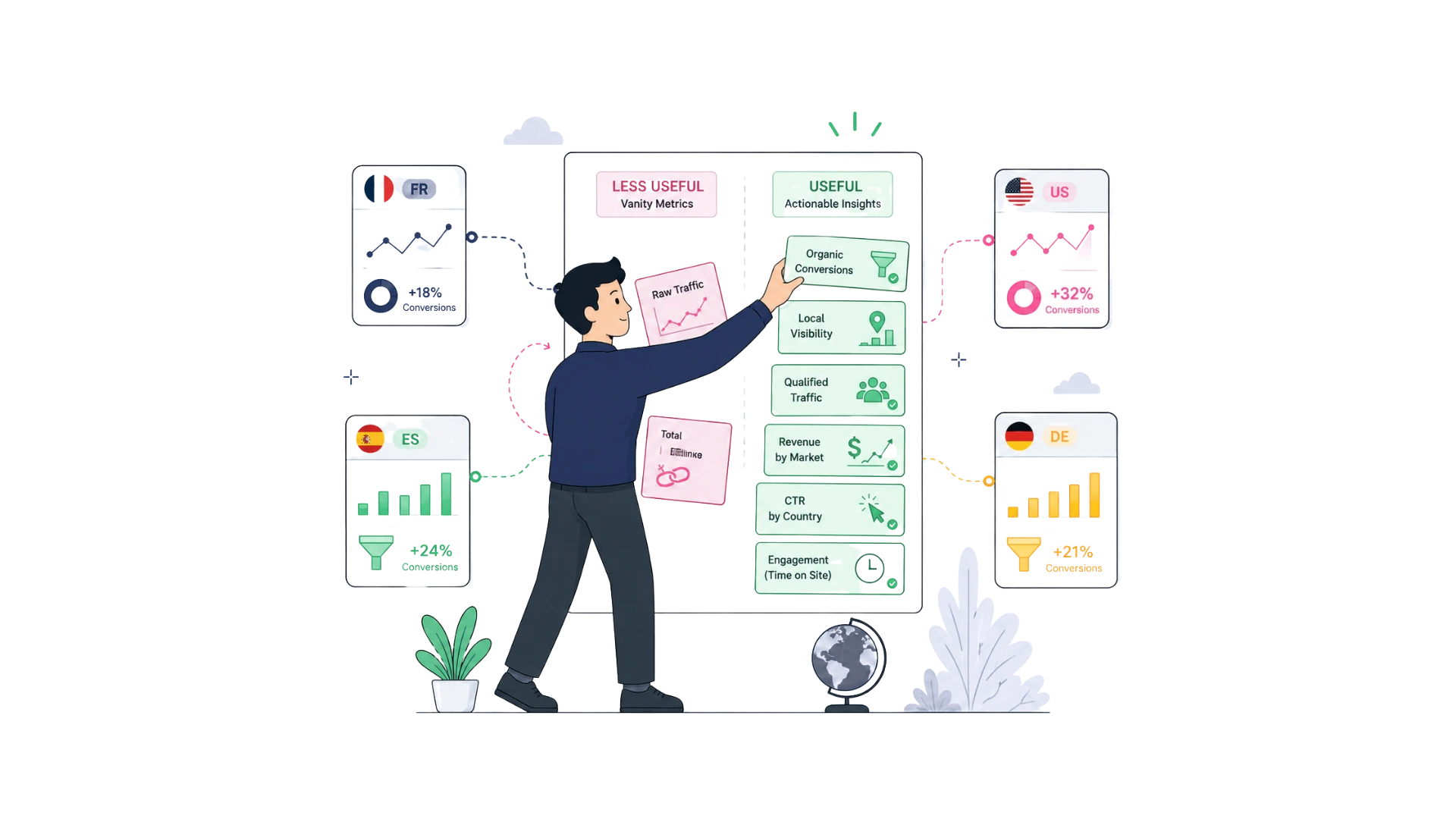
Most businesses look at aggregate traffic from a single dashboard. For international SEO, that is a blind spot.
Effective international SEO reporting transforms complex data into actionable insights that drive business decisions. Build executive-level international performance dashboards. Track revenue and conversion rate trends by market, monitor progress against penetration goals, and compare ROI across countries.
Measure these per locale, not as a global aggregate:
Mobile versus desktop ranking variations often differ between markets based on local device usage patterns. Some markets show significant mobile preference while others maintain desktop dominance. Tracking both mobile and desktop rankings provides complete visibility into market-specific search behaviors.
International SEO monitoring requires tools that provide accurate data across different search engines, countries, and languages. Semrush, Ahrefs, and Sistrix offer international tracking capabilities with country-specific databases. Google Search Console provides official performance data, but requires a separate property setup for different international versions.
For markets where Google is not dominant, platform-specific tools matter. Local SEO tools become important for markets dominated by non-Google search engines. Baidu Analytics for China, Yandex Metrica for Russia, and Naver Analytics for South Korea provide essential insights that global tools cannot capture.
Measurement is not a one-time setup. Schedule regular per-market reviews. The data gaps you find after three months will shape the next six months of execution.
The opportunity is bigger than most businesses realize.
The SEO services market in 2026 is estimated at USD 83.98 billion, growing from a 2025 value of USD 74.9 billion, with 2031 projections showing USD 148.86 billion at a 12.12% CAGR. More businesses are competing for international organic visibility than ever before. By geography, APAC is forecast to record the fastest CAGR of 13.55% between 2026 and 2031. If you are eyeing Asian markets, the window to establish early authority is narrowing.
The results from real businesses make a strong case.
Beauty brand Gisou saw a 1,365% surge in global organic traffic after strategically optimizing product pages, content, and backlinks for each target market in different countries. These are not outliers. They are the result of following a structured process, market by market.
According to DeepL’s survey of marketers in 2024, 96% reported seeing positive ROI from localization efforts, and 65% reported at least 3x ROI.
But here is the complication: Google holds about 89.2% of global search traffic, making it the main focus for any SEO effort. That is true in most markets. But not all of them. Local SEO tools become important for markets dominated by non-Google search engines. Baidu Analytics for China, Yandex Metrica for Russia, and Naver Analytics for South Korea provide essential insights that global tools cannot capture.
A single-engine strategy will fail in those markets. Your international SEO strategy has to be market-aware from the start.
Use this international SEO checklist as a working reference before, during, and after launching in a new market.
Strategy and Market Research
Site Architecture
Technical SEO
Content and Localization
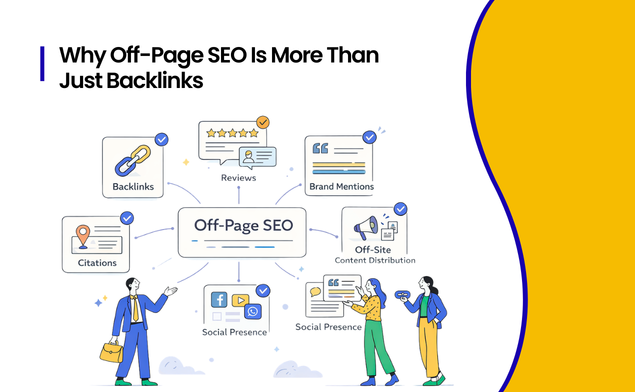
Off-Page and Authority Building
Measurement and Tracking
The gap between businesses that achieve international rankings and those that do not is almost never ambition. It is a structured execution.
Architecture, hreflang, localized content, and local authority have to work together. Miss one layer and the others underperform. Build all four correctly, and the compounding effect is real: websites using SEO localization see a 70% increase in organic traffic within 12 months, as stated by Weglot.
International SEO is not a translation project. It is a market-entry discipline with technical, content, and authority-building dimensions that each require dedicated effort. Brands with structured international SEO governance deliver 2.3x higher ROI over two years compared to those localizing ad-hoc. The difference is a documented, systematic approach, not a sprint.
Start with the markets where demand already exists for what you sell. Validate it in the data before investing in localization. Build the technical foundation before publishing content. Earn local authority before expecting local rankings.
If you are planning to expand into new countries through organic search and want expert guidance on building the right approach, the team at Digital SEO Land offers international SEO services tailored to your specific markets and business goals. Talk to an international SEO expert who has done this work before you invest in doing it at scale.

AI Services





Link Building





Resources