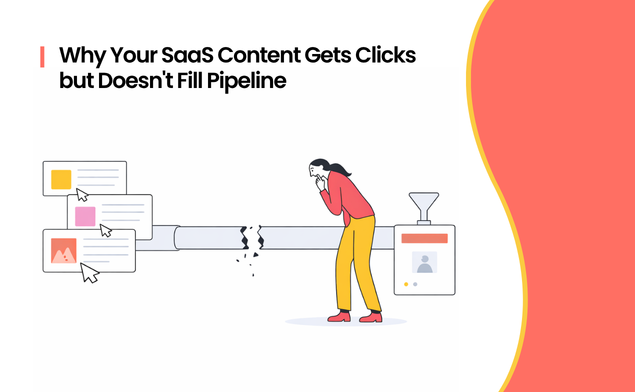


Picture this: your content team shipped 12 blog posts last quarter. Traffic is up 40%. The marketing report looks good. And then your head of sales asks a simple question
How many of those visitors booked a demo?
Silence.
This is one of the most common and expensive disconnects in SaaS marketing today – Content that earns Google’s approval, attracts thousands of readers, and generates zero qualified pipeline.
Traffic and revenue are being treated as the same thing, when they’re not even on the same map.
If your content programme is producing pageviews but not pipeline, this piece is for you.
96% of tech marketers report having a content marketing strategy in place, yet only 29% consider that strategy to be extremely or very effective.
That gap between doing content and doing it in a way that actually works is the core issue.
The funnel data makes it even starker.
The B2B SaaS industry has a visitor-to-customer conversion rate of just 1.1%.
And yet, the delta between average performers and top performers is enormous:
The top 10% of B2B SaaS companies convert visitors to leads at 8–15%, while average companies struggle at 1.5%.
The gap doesn’t come from having better-written content. It comes from a fundamentally different approach to what content is supposed to do.
The 2025 B2B SaaS funnel data showed MQL-to-SQL as the key bottleneck, with average 15–21% conversion. And improving this stage by just 5 points can lift revenue by up to 18%.
That’s the stage where most content-sourced leads fall apart. They arrive. They don’t qualify.
The reason almost always traces back to the same root cause: the wrong intent.
The single most common and most expensive mistake in B2B SaaS keyword research.
Optimising for volume produces traffic. Optimizing intent produces a pipeline. The two are not the same metric, and treating them as equivalent is one of the primary reasons B2B SaaS content programmes generate impressive traffic reports and disappointing revenue outcomes.
Here’s what this looks like in practice:
A SaaS company that sells project management software writes a post called “What is Agile methodology?” It ranks on page one. It gets 8,000 visits a month. And it attracts students, developers curious about processes, and people who will never buy project management software in their lives.
The post wins clicks. It misses the pipeline.
One of the biggest mistakes SaaS companies make is chasing high-volume keywords that attract readers but not buyers. An article that ranks well but attracts early-stage researchers may look successful in SEO analytics dashboards, but in reality it may contribute very little to pipeline or revenue.
This is the core tension most SaaS content teams haven’t resolved.
They’re being measured on traffic and ranking positions. But the business cares about trials, demos, and revenue.
Those are two completely different scorecards.
The relationship between search volume and conversion rate in B2B SaaS is almost perfectly inverse.
The keywords with the highest search volume attract the widest and least purchase-ready audience.
Buyers who are close to a decision don’t search for “what is CRM software.”
They search for things like “Salesforce alternatives for small teams,” “HubSpot vs Pipedrive pricing,” or “best CRM for e-commerce.” Lower volume. Higher commercial proximity.
Decision-stage SEO content targets the keywords buyers search when they’re actively evaluating options.
For example: Category terms (“project management software”), comparison terms (“Asana vs Monday”), and alternative terms (“Salesforce alternatives”) all signal high buying intent. For SaaS content teams these pages should exist before anything else in the content library.
The data from a client’s work makes this concrete.
One B2B SaaS company was running a content strategy that generated traffic but monthly conversion was near zero.
When the data was examined, a few bottom-of-funnel posts targeting keywords with clear buying intent were converting at 6 times the rate of everything else, despite sitting well outside the top ten posts by traffic volume.
That insight gave the client confidence to stop prioritising volume and start prioritising commercial proximity and the result was a leap in monthly trial signups from content.
Fewer posts, right intent, dramatically more pipeline.
Many SaaS companies focus all their effort on awareness content(or TOFU content as some people like to refer to) and wonder why traffic doesn’t convert. In reality you need content for the bottom of the funnel to close deals. Period.
Quickly here’s what that looks like in practice:
Comparison and alternative content is often neglected because it feels uncomfortable to name competitors. But buyers are already comparing.
So if you don’t provide that comparison, someone else will, and they’ll control the narrative.
70% of B2B marketers believe case studies are the best content format for converting leads to deals. Yet most SaaS blogs have a handful of case studies buried in a sub-folder, written once and never updated.
Case studies excel at increasing win rates. Sales teams report up to a 28% boost in close rates when customised case studies are included in proposals. That’s a good number to work with.
55% of B2B buyers say thought leadership content has significantly influenced their purchasing decisions.
But the key word is *thought leadership*, not thought following. Generic listicles and “best practices” roundups don’t qualify here.
What earns backlinks, gets cited by AI tools, and actually moves the pipeline is original research, a distinctive point of view, and content built on genuine customer insight.
Use-case and role-based content speaks to specific people with specific problems. A page explaining how your platform helps RevOps teams consolidate reporting is more useful than a generic features page, because it mirrors how the buyer actually thinks about their own situation.
Even when your content attracts the right people, there’s another wall they hit: the MQL-to-SQL handoff.
The average MQL-to-SQL conversion hovers around 13%, but teams with strong behavioural scoring and tight ICP coverage can hit 30–40%, dramatically increasing meetings per marketing dollar.
That 13% average isn’t a sales problem. It’s often a content problem dressed up as a sales problem.
When blog readers fill out a form to download an e-book but have no purchase intent, they inflate your MQL count and waste your sales team’s time. The content attracted the wrong person at the wrong stage, and the qualification system took the blame.
Companies with active blogs generate 67% more leads per month than those without. But leads are not in the SQL pipeline and that distinction is where most content programmes fail.
Getting this right means building your lead-capture mechanisms around the content’s intent.
A TOFU post about industry trends? Gate it lightly, or not at all.
A BOFU comparison page? That’s where your demo CTA belongs, prominently placed.
Not all clicks are created equal. The likelihood that someone converts can vary greatly depending on search intent which is again broadly categorised as top-of-funnel (informational), middle-of-funnel (comparison or consideration), or bottom-of-funnel (transactional or navigational).
This isn’t abstract. Consider what happened to one of the most respected content engines in B2B SaaS.
HubSpot reportedly experienced traffic declines of 70–80% as AI Overviews rolled out through 2025.
Their strategy was purpose-built to dominate high-volume informational keywords. When those keywords started getting answered directly on the search results page, the architecture that made HubSpot’s content engine so impressive became the same architecture that made it so exposed.
HubSpot is not a cautionary tale about bad content. Their content is in fact excellent. It’s a cautionary tale about strategic dependency on a single traffic model for one that assumed informational search would always generate clicks.
Google’s AI Overviews now appear across a growing share of search queries, and the impact on click-through rates is severe.
AI-generated search features are suppressing clicks even for top-ranking content. Ahrefs found that, as of December 2025, AI Overviews reduced organic click-through rate to the top-ranking page by 58%.
And the queries most affected are exactly the ones that volume-first SaaS strategies target: informational, educational, and definitional searches.
The playbook that worked three years ago is now structurally fragile. The SaaS companies that continue to invest primarily in broad informational content are building on sand.
Most SaaS content teams don’t need more content. They need an honest look at what they already have.
Start here: pull your top 20 posts by traffic.
Now check how many of those pages have a meaningful CTA connected to your pipeline. Like a demo request, a free trial, a consultation.
Then check the conversion rates on those CTAs.
What you’ll likely find is that your highest-traffic pages are driving almost no pipeline action.
Industry benchmarks suggest it’s often just the top 5–10% of your content that will generate most of your organic traffic.
The real question is: do those pages convert?
If your best-trafficked content is all informational, your programme is built for readers, not buyers.
Next, map your content against the three funnel stages and be honest about the distribution.
Most SaaS content libraries are 80% TOFU. Whereas, the MOFU and BOFU content that buyers actually need when they’re evaluating options, comparisons, use-case pages, customer stories, ROI calculator, is often thin or most of the time non-existent.
Targeting the wrong audience means creating content for people who will never convert, regardless of traffic volume.
B2B SaaS companies frequently make this mistake by optimising for broad, informational queries instead of commercial intent keywords that indicate buying readiness.
Finally, look at your content attribution in your CRM.
Focus on conversion metrics that predict revenue and track organic trial signups, product qualified leads (PQLs), and marketing qualified leads (MQLs).
These conversions are directly associated with your content efforts and are leading indicators of future revenue growth.
The fix isn’t abandoning top-of-funnel content.
It’s rebalancing your programme around commercial intent, and making sure every content type has a clear role in the pipeline.
Build your BOFU content first. Comparison pages, “alternatives to” pages, use-case landing pages, customer case studies.
These pages convert.
Organic search leads convert to customers at about 14.6%, compared with only 1.7% for pure outbound leads. But only when those organic visitors arrive via content that matches their buying intent.
Then build upward from there. Reverse funnel tactic.
Use MOFU contents like webinars, detailed guides, ROI frameworks to nurture the people your TOFU content brought in.
Connect everything with intelligent internal linking so a reader who lands on a broad post has a clear path to your more conversion-oriented pages.
The average B2B customer journey takes 211 days and requires 76 touches before purchase.
Given this timeline, platform selection must support long-term nurturing rather than immediate conversions. Your content programme is not a one-click purchase funnel. It’s a relationship over months. Every piece of content either strengthens that relationship or wastes it.
Measure what matters. Traffic is a proxy metric, not a goal.
47% of buyers will view 3 to 5 pieces of content before engaging with a company’s sales representative
Which means your content needs to be guiding that journey deliberately, not passively accumulating pageviews.
The SaaS content problem isn’t a writing problem. It isn’t even a keyword problem.
It’s a strategic misalignment between what content is being produced and what the business actually needs.
Traffic is easy to report. Pipeline is harder to attribute. So teams default to traffic because it feels like progress. It’s not.
The SaaS companies that win with content in the current environment are the ones treating it as a pipeline generation system with clear commercial intent at its core.
Every piece of content you publish should have a clear answer to one question: who is reading this, and what do I want them to do next?
If that answer is “everyone, and nothing specific,” you’re spending a budget on an audience that will never buy.
If your content looks great in monthly reports but your sales team barely sees pipeline from it, the problem is solvable.
It just requires building a strategy that’s designed for buyers, not browsers.
At Digital SEO Land, we work with SaaS companies to build content strategies that connect organic traffic directly to qualified pipelines, through intent-mapped content, BOFU-first execution, and attribution frameworks that make the connection visible.
If you want to see what that looks like for your product, explore our SaaS SEO Services.

AI Services


Link Building




Resources