
AI


In July 2024, OpenAI introduced SearchGPT, an AI-powered search engine that showed the internet a different way of online information search.
For digital marketers and website owners like us, this marked a big shift in the search landscape.
Generative AI tools like ChatGPT and SearchGPT aren’t just augmenting traditional search behavior; they’re reshaping it entirely.
Unlike conventional search engines that direct users to links, these platforms deliver instant, conversational answers. This change in information consumption has raised a critical question for businesses:
How can your content remain visible and relevant in this new ecosystem?
The answer lies in adaptation.
Traditional SEO practices, while still immensly valuable, might not be the exact fit for these platforms. Success on AI-driven search platforms(like ChatGPT, Perplexity, Gemini)requires a deep understanding of user intent, creation of semantically rich content, and focus on brand engagement.
In this guide we’ll talk about the emerging practice of Generative Engine Optimization (GEO)—a strategy designed to ensure your website remains discoverable in AI powered search engines.
Whether you’re a marketer, business owner, or content creator, this article will help you understand:
Let’s start by exploring what sets ChatGPT optimization apart from traditional methods.
At first glance, optimization for traditional search engines and generative AI search engines might seem quite similar.
After all, they both rely on well-structured, high-quality content to provide what the users are looking for. The overlap exists because AI tools like ChatGPT still draw on indexed web content to generate responses.
However, the way they retrieve and present information is where the difference lies.
So how does this change things for website owners? Let’s see what sets them apart to understand how to create a killer strategy.
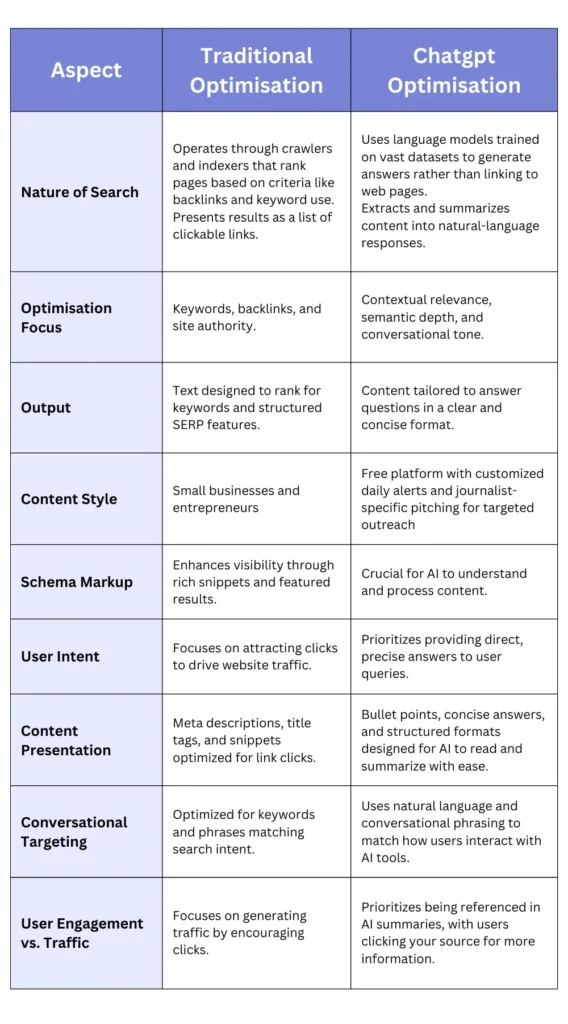
It’s clear that to get your content floating on AI search engines like ChatGPT you might have make some shifts in your content marketing strategies. Because now more than ever the focus of search is on user intent, semantic content and giving people what they want in the most direct and optimal way possible.
Let’s discuss some solid reasons why you should have a plan in place to optmise your content for AI search platforms.
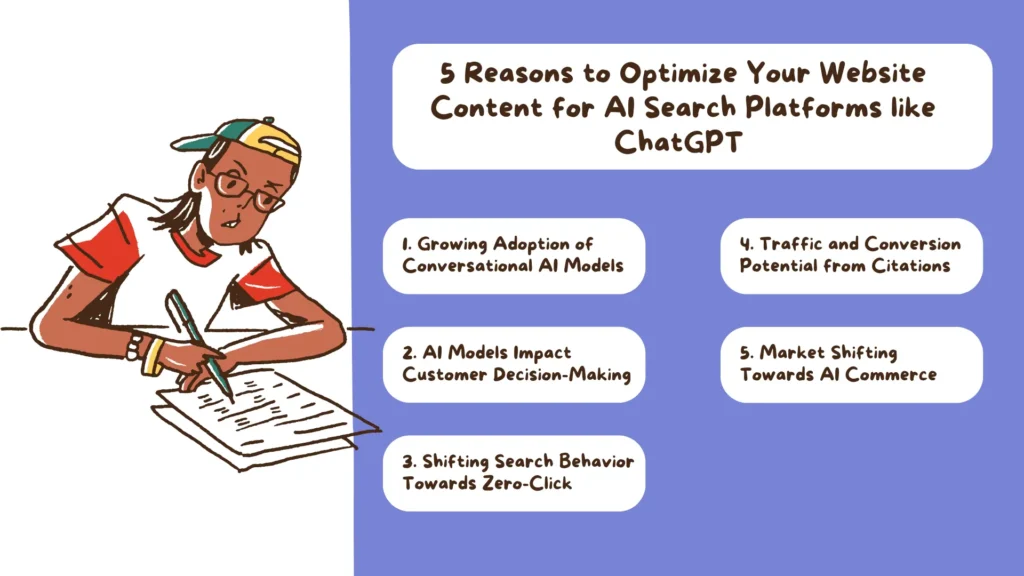
The short answer is – to stay ahead of the curve and ensure your content remains discoverable in the era of AI-powered search.
Here is a list of reasons to justify why you should optimise your website content for AI search engines:
The latest November 2024 data reveals that ChatGPT attracts 464 million monthly visitors. This simply means that a lot of users are choosing direct, conversational interactions.
So, it makes sense that your website is part of its responses to remain visible to a large number of audiences.
More people are now using AI tools like ChatGPT to research before making complex purchases. This is especially true for tech or finance products. A 2023 HubSpot survey has confirmed this fact.
So what if AI tools recommended your website to potential customers? That means you are influencing potential customers’ decisions directly. And that too without having to fight for those clicks in the usual search results.
Did you know that the number of Google searches that end without a single click increased in just two years? A SparkToro study from 2021 found that 65% of Google searches ended without a single click.
This zero-click search trend is not going away anytime soon, especially now when people are turning to tools like ChatGPT.
Even though being cited as a trusted source by ChatGPT can keep your brand in the spotlight. People will still want to learn more from the experts, and that’s where your website comes in. They will come to you for the in-depth information they cannot get from a simple AI summary.
OpenAI (ChatGPT’s creator) and Google’s Search Generative Experience (SGE) often include links to their sources. Being cited in these AI-generated responses can attract a highly engaged audience.
Users looking for detailed answers are more likely to click on cited websites to learn in more detail. This means your website gets an opportunity to pull in traffic and may be conversions simply by being a part of these summaries.
It’s a great way to position your content in front of the right audience without competing for traditional search rankings.
Gartner predicts a massive shift towards AI. By 2026, they believe that half of all knowledge workers will use AI tools daily. And 20% of customer interactions will involve conversational AI.
This shift is driving businesses to adopt AI-first strategies. When your website is featured in ChatGPT results, you are not just getting visibility, you are positioning yourself right at the heart of this growing AI ecosystem. This ensures your business stays competitive and relevant in the field.
So, we have made our point that optimizing your website content for ChatGPT can turn out to be a game-changer for you.
But how exactly do you go about it? That is what the next section is about. Let’s get to it.
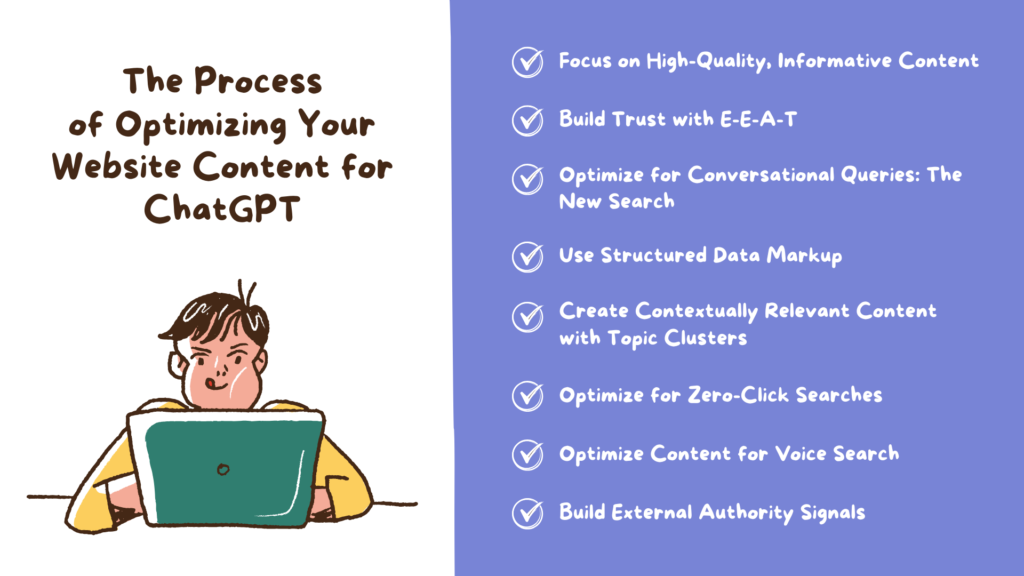
Before delving into the strategies, let’s introduce the topic of Generative Engine Optimization (GEO) – the process of ensuring that your content shows up in AI responses.
Here is how it works:
GEO applies to various tools like Perplexity, Google Overview AI, and more. The strategies we will explore in the next section are specifically for ChatGPT or SearchGPT.
AI favors accurate, in-depth content that answers questions well. Keep the following in mind:
For instance, instead of generic terms like “SEO Tips,” try breaking it down into sections like “SEO Strategies for Beginners,” “Common SEO Mistakes to Avoid,” and “Top SEO Tools for 2026.”
E-E-A-T stands for Expertise, Experience, Authoritativeness, and Trustworthiness. ChatGPT favors content that shows these qualities. Here’s how you can ensure that your content has it:
Unlike search engines (Google), ChatGPT understands natural language questions. So, make sure you optimize your content in the below manner:
Structured data acts like a roadmap for AI. It helps AI better understand your content and easily grasp the purpose of your website and what your business is all about.
Here are some examples of how to use structured data markup:
Just like a map helps you find your way through unknown terrains, structured data helps ChatGPT find its way to the most relevant information on your website.
AI works better when it understands the context of your website content. Organize your content around specific topics in clusters. Then create a hiearchical topic cluster format with help of internal links. This helps AI understand the broader context of your website’s focus.
Not only does it make your site look like an expert in the domain, but it also increases the chances of your content being referenced in AI-generated responses.
Generative AI tools like ChatGPT give users answers right away without sending them to your website. Here’s how to keep your content important even then:
People are using voice assistants and chatbots more and more. When people use voice search, they are looking for quick and easy answers. So, write your content in a way that feels like you are having a conversation with them.
Voice search is all about asking questions. So, write your content to answer those questions directly. For example, instead of just listing “top restaurants,” answer questions like “What are the top-rated restaurants in this area?”
ChatGPT pays attention to what other websites and people say about you. Here’s how to build authority:
There’s no denying that the way we search online has totally changed thanks to AI search engine tools like ChatGPT or SearchGPT.
To keep up, businesses need to make sure their websites are received and perceived well by these AI models. Not only will this make their brand more visible, but it will also help them stay relevant in this fast-changing world of generative AI.
So, why not start optimizing your website and see what conversational AI can do for your business?

AI Services





Link Building






Resources