SEO



For most startups, the fastest way to reduce CAC isn’t better ads. It’s shifting more growth to organic channels that don’t charge you for every click.
When SEO pages keep bringing leads month after month, emails convert users you already paid to acquire, and referrals start coming in without extra spend, CAC drops naturally.
Not overnight, but consistently.
That’s why many startups eventually see organic customers costing a fraction of paid ones, while staying longer and generating more revenue.
This doesn’t mean switching ads off or waiting years for results. It means building an organic system alongside paid growth, so your acquisition costs stop climbing every time you scale.
In this guide, we’ll break down how startups can reduce CAC by moving toward organic channels, what to focus on first, and how to make the shift without slowing growth.
For most startups, rising CAC isn’t a sudden problem. It creeps up quietly as the business scales.
Customer Acquisition Cost (CAC) is the total amount you spend to acquire one paying customer. This includes ad spend, sales tools, marketing software, agency fees, and the time your team spends converting leads. If you spend $10,000 in a month and acquire 50 customers, your CAC is $200.
The issue is not that paid channels stop working. The issue is that they get more expensive over time.
As more startups enter the same market, they compete for the same keywords, audiences, and placements.
Naturally, bids go up, attention gets fragmented, and the cost of acquiring each additional customer increases.
Hence, what worked at an early stage starts breaking as you scale.
Another problem is that paid growth resets every month. When you stop spending, traffic stops.
There’s no carryover effect.
You’re constantly rebuying the same attention, even from people who have already seen your brand before.
Blended CAC also hides what’s really happening. When all channels are lumped into one number, it becomes hard to see which sources are driving efficient growth and which ones are quietly draining budget.
Paid might be propping up short-term numbers while pushing long-term CAC higher.
This is why many startups feel stuck. They’re growing, but each new customer costs more than the last. Without another acquisition engine in place, scaling becomes expensive and risky.
That’s where organic channels start to matter and startup SEO strategies come into the picture. They don’t necessarily replace paid growth, they rather change the economics of how customers are acquired over time.
The biggest difference between paid and organic channels isn’t cost. It’s how they behave over time.
Paid acquisition scales linearly. If you want more customers, you spend more. Every click, impression, or install has a price attached to it, and that price usually goes up as competition increases. There’s no memory in the system. Each month starts from zero.
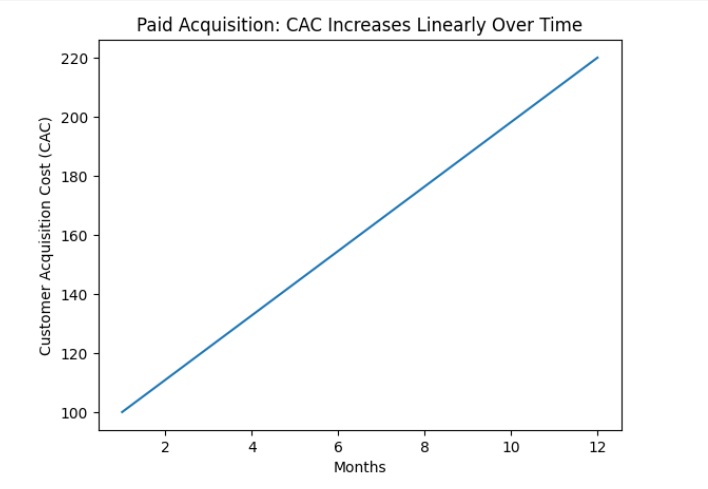
Organic channels work on a completely different curve. The upfront effort is higher, but the marginal cost keeps dropping. A well-ranking SEO page, a useful resource, or a strong email list continues to bring in leads without requiring the same level of spend again and again. This is what allows CAC to trend downward instead of upward.
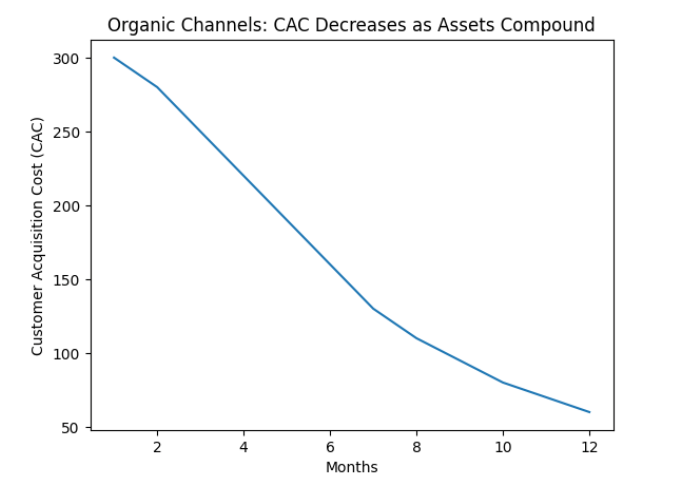
With organic growth, most of the cost is front-loaded. That means, you invest in content, SEO, email infrastructure, or community building once, and the output keeps working long after it’s live.
For example, a blog post that ranks well doesn’t disappear at the end of the month. It keeps attracting qualified traffic.
Or, an email list doesn’t charge you per open. A community doesn’t need ad spend to keep conversations going.
Over time, the same investment supports more customers, which naturally brings CAC down. This compounding effect is why organic growth feels slow at first but powerful later.
In the early months, CAC may even look worse because you’re investing without immediate returns(maybe you can start building some laser focused PPC campaigns).
But as assets stack up, each new customer costs less to acquire than the previous one.
There’s another advantage that often gets overlooked. Organic customers usually arrive with higher intent. For example:
That pre-qualification reduces friction in the funnel. As a result, organic users tend to:
Higher retention and lifetime value mean you can afford to spend less to acquire each customer, even if growth is slower at the start.
This is why startups that lean into organic early often look inefficient at first, then suddenly pull ahead. As a result their CAC doesn’t just drop, it stabilizes, making growth more predictable and sustainable.
Shifting to organic channels only works if you’re intentional about what you build.
Publishing blogs, sending emails, or posting on social media without a clear goal won’t move CAC in a meaningful way.
The goal is simple: create systems that bring in high-intent users and convert them efficiently over time.
SEO reduces CAC when it targets people who are already looking for a solution, not when it chases broad awareness.
Early on, many startups waste effort trying to rank for short, competitive keywords that sound impressive but rarely convert.
High-intent long tail search queries are usually longer, more specific, and closely tied to a buying decision.
For example:
Ranking for these queries brings visitors who are much closer to becoming customers.
Thus making conversion rates higher, sales cycles shorter, and fewer marketing touches are needed, all of which push the overall CAC down.
To make this work, SEO can’t live based on generic SEO strategy. Pages should be built around real product use cases, common objections, and decision criteria.
This is where a pillar-and-cluster structure helps. One strong core page anchors the topic, while supporting content answers related questions and helps building authority.
Over time, this structure compounds. Each new page strengthens the whole system, making future rankings easier and cheaper to earn.
Traffic alone doesn’t reduce CAC. Conversions do.
Many startups invest in content that educates but never moves readers closer to action. Organic CAC only drops when content is tied directly to acquisition or activation.
Conversion-focused content usually sits closer to the bottom of the funnel:
Each piece should have a clear next step. That can be
Even small improvements in conversion rate have an outsized impact on CAC when traffic is consistent.
Email is one of the most overlooked organic channels for CAC reduction.
Once someone joins your list, reaching them again costs almost nothing(apart from the cost of the automation tool you are using).
The key to effective email marketing is relevance.
Instead of sending the same message to everyone, segment users based on what they’ve viewed, downloaded, or signed up for.
For example, a founder exploring pricing needs different messaging than someone reading educational content.
Automated email sequences make this scalable. Welcome flows, onboarding emails, and behavioral triggers run continuously in the background, improving conversion without increasing headcount or budget.
Community and referrals are often the lowest-CAC channels once they gain momentum.
When customers feel connected to your product and your team, they naturally share it with others. This creates a flywheel effect where existing users help acquire new ones without paid spend.
Early communities don’t need to be large. A small, focused group that shares problems and solutions can generate meaningful word-of-mouth. Over time, this social proof feeds back into content, SEO, and sales conversations.
Referrals and community growth don’t scale instantly, but when they click, they dramatically change acquisition economics.
Organic social works best when it supports the rest of your growth system.
Instead of trying to go viral, startups see better results by using social channels to:
For most B2B startups, this means focusing on one primary platform and showing up consistently with
These tend to outperform polished marketing posts. But it has to be consistent. Without consistency no strategy will work.
As a result, strong organic social signals improve downstream performance. Warmer audiences convert better across email, SEO, and even paid campaigns, reducing overall acquisition costs.
One of the biggest mistakes startups make is treating organic growth as a replacement for paid acquisition. That approach almost always backfires.
Organic channels take time to build. Turning off paid too early can dry up leads before organic systems are ready to carry the load. The smarter move is to rebalance, not replace.
Not all paid spend is wasteful. Some campaigns play a critical role even as you invest more in organic.
Brand search, retargeting, and high-intent bottom-of-funnel campaigns are usually worth keeping. These channels capture demand that already exists and often have shorter payback periods.
Cutting them entirely can hurt conversions that organic efforts are still warming up.
Paid can also be useful for learning. For example, small, controlled campaigns help test messaging, positioning, and use cases quickly. The insights you get from paid performance can then guide what you double down on in SEO content, landing pages, and email sequences.
The goal is to stop using paid as your only growth lever, not to eliminate it altogether.
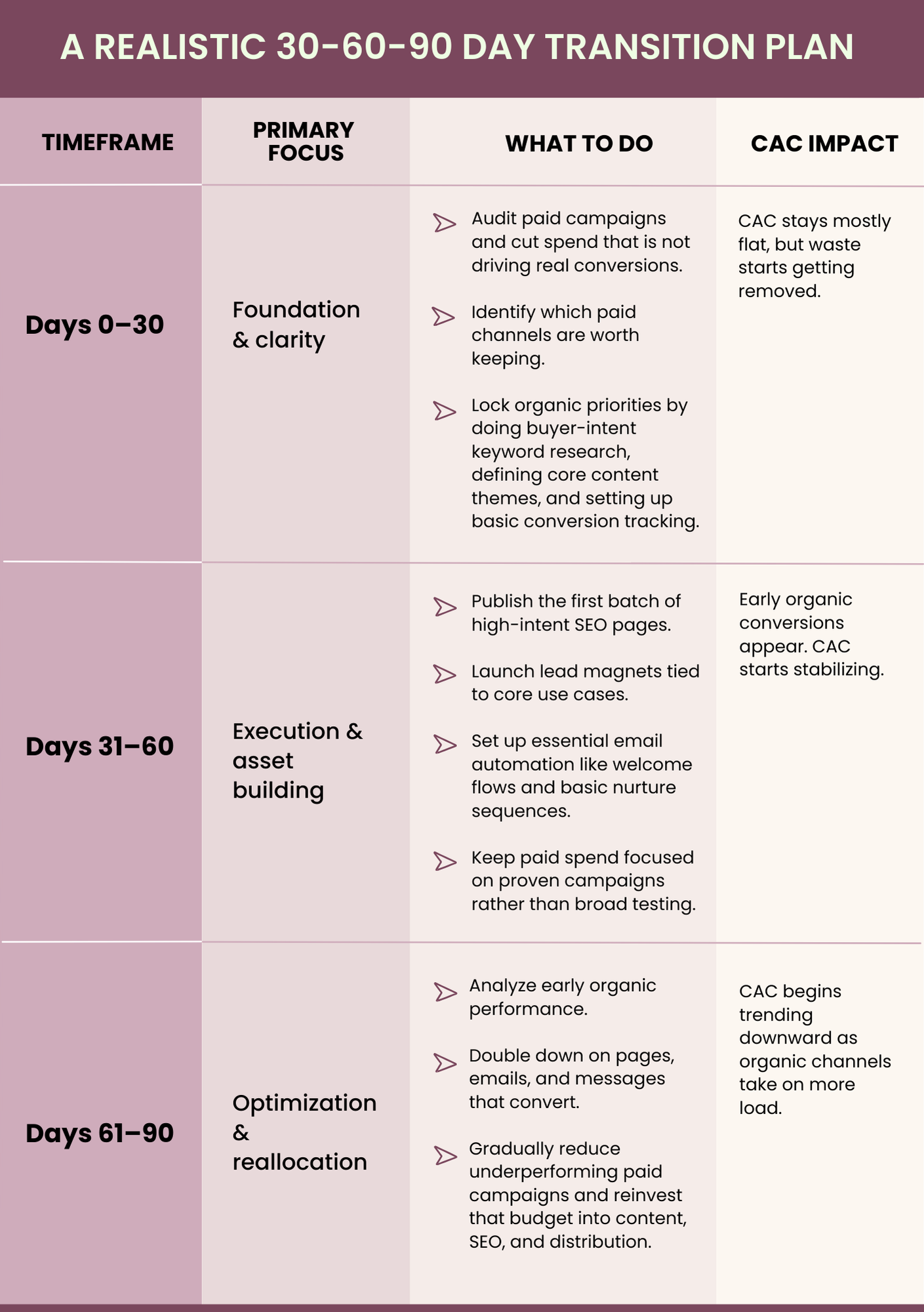
Organic growth only helps if it’s measured properly.
Without the right metrics, it’s easy to assume things are working when CAC hasn’t actually moved.
Blended CAC hides too much. To understand what’s improving, you need to calculate CAC separately for organic search, email, referrals, social, and paid channels.
Start by tracking the total organic costs, like costs involved in content creation, tools, and internal effort.
Now divide that by the number of customers acquired from organic sources over the same period. This gives you a clear organic CAC number you can monitor over time.
As organic assets compound, this number should trend downward even if spend stays relatively flat.
Traffic and engagement are useful signals, but on their own, they don’t tell you whether CAC is actually improving. The real impact of organic channels shows up deeper in the funnel.
Here are some metrics that will start matter the most:
Lower CAC isn’t about finding shortcuts. It’s about building acquisition systems that get more efficient over time.
Startups that invest early in organic channels create leverage. They’re less dependent on rising ad costs, more resilient to market shifts, and better positioned to scale sustainably.
Paid growth can unlock speed. Organic growth builds stability. When the two work together, CAC stops being a bottleneck and becomes a competitive advantage.

AI Services



Link Building


Resources