AI
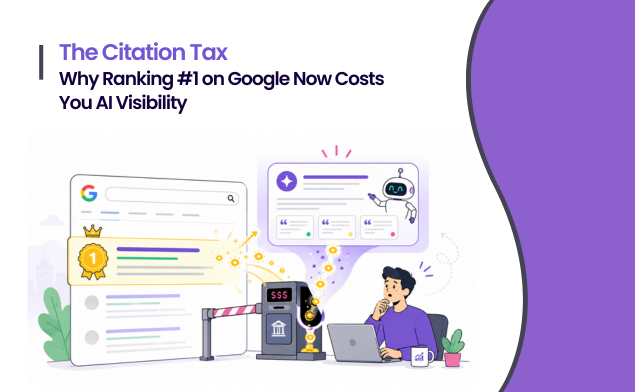

The Citation Tax is what happens when an AI Overview uses your content to answer a search query, but does not send the user to your site. You invest in ranking. The AI collects the value. The click never arrives. AI Overviews now appear in over 50% of all searches, which means this is already happening at scale.
This post covers the cause, the scale, and what to do about it.
You check your rankings. Position one. Everything looks normal.
Then you check traffic. It is down. Significantly.
This is the core experience behind the Citation Tax, and it is not a reporting error. AI Overviews sit above organic position one and answer the query directly. The user gets what they came for without clicking anything. Your ranking stays intact. Your traffic does not follow.
The data confirms it. According to Ahrefs’ December 2025 findings, AI Overviews reduce position-one CTR by 58%. Seer Interactive’s September 2025 study found organic CTR fell from 1.76% to 0.61% for queries with AI Overviews, a drop of 61%.
Rankings are now a lagging indicator of a problem that may already be working against you.
Here is where it gets more uncomfortable.
Being cited inside an AI Overview does not automatically fix the traffic problem. AI citations function as trust signals for the AI’s own output, not as referral links. The user sees “according to X” and moves on. Their question is answered. There is no reason to click.
Forbes was cited 44,131 times in AI Overviews and still lost 50% of its organic traffic, according to Digital Bloom’s 2025 analysis. HubSpot lost between 70% and 80% of its organic traffic between late 2024 and mid-2025, per Demand Local’s 2026 report. Both brands did everything the traditional playbook required. The system extracted the value anyway.
Similarweb’s 2024 data found that 65% of searches now end without a click. AI Overviews have accelerated that pattern considerably since then.
The loss is often invisible at first. It does not appear as a bounced session or a failed conversion. It shows up as a pipeline gap several months later, with no obvious cause.
Every prompt in your category where a competitor is cited, and you are not, is a documented loss of influence at the exact moment a buyer is deciding.
This is what a Citation Gap looks like in practice. Someone asks a question directly relevant to your business. The AI delivers an answer. Another brand is referenced. Yours is not. That is not a hypothetical risk. It is a measurable gap in your visibility.
Traditional SEO audits track keyword rankings and organic traffic. AI citation gap analysis maps the specific prompts, topics, and competitive contexts where AI platforms choose other brands over yours.
The stakes are higher than they appear. LLMs cite only 2 to 7 domains per response on average, according to Frase.io’s 2026 research. That is a far smaller competitive set than Google’s ten blue links. And 47% of AI Overview citations now come from pages ranking below position five, which means strong organic rankings alone do not guarantee citation eligibility.
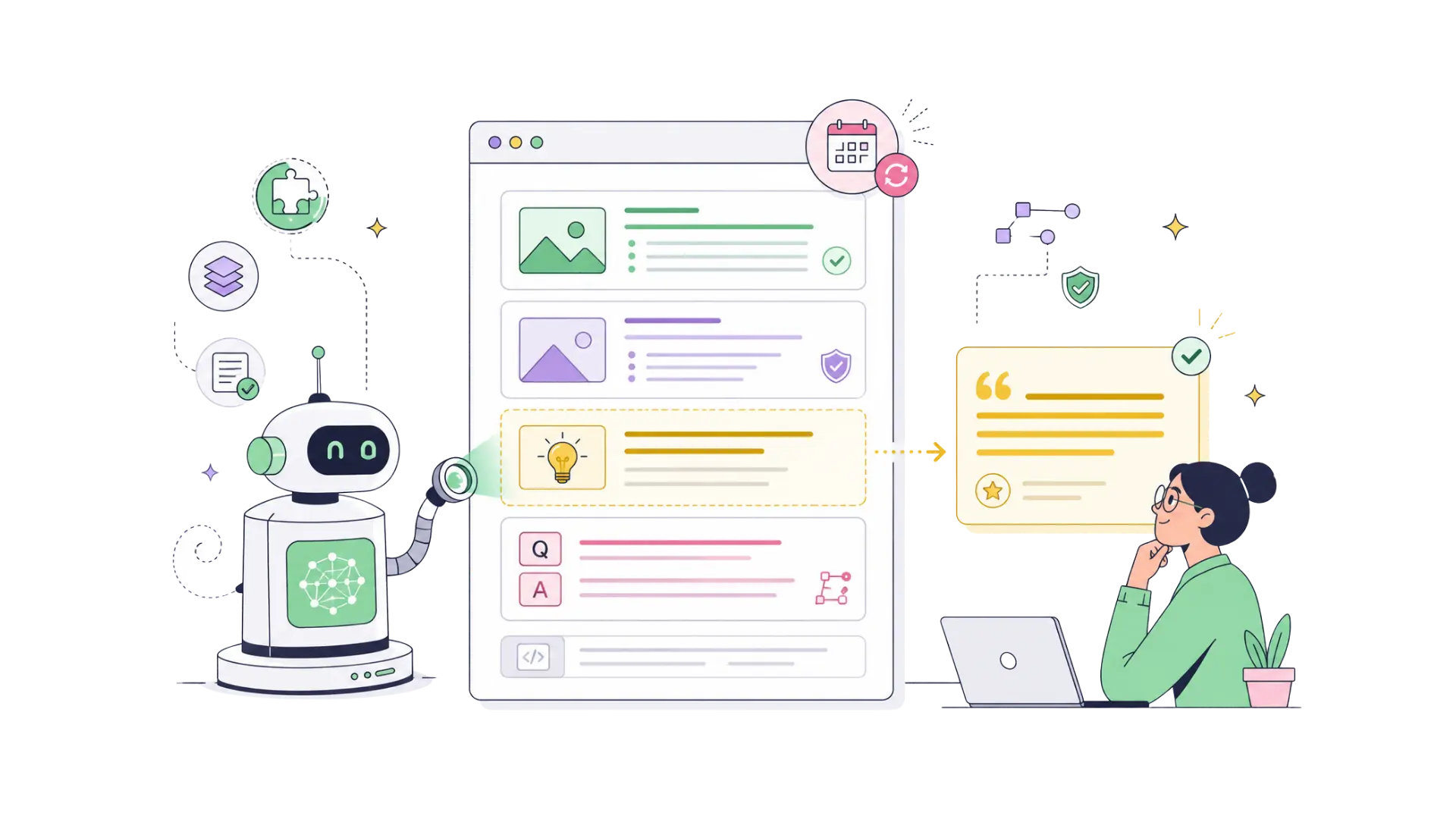
The Citation Rule is not a single algorithm. It is a set of content characteristics that make a page easy for AI systems to extract, trust, and reference. Understanding these characteristics is where strategy begins.
AI engines break content into small fragments and reassemble them to answer user queries. Sections that stand alone and answer a question completely get pulled more often than dense, interconnected paragraphs.
Research from Wellows in 2026 found that content scoring high on semantic completeness is 4.2 times more likely to be cited. Structured content chunks are cited 65% more frequently than connected prose, according to Siftly’s analysis.
Write sections that can answer a question even when read in isolation.
Early data suggests that pages with proper schema markup are approximately three times more likely to earn AI citations. FAQ sections structured as question-and-answer pairs are consistently among the most cited content formats. Each question acts as a heading. Each answer opens with a complete, self-contained response of 40 to 60 words.
Clear hierarchy, clean markup, and verifiable claims all reinforce the signals AI systems use to assess trust.
Research from 5WPR in 2026 found that content shows a measurable decline in AI citation frequency after 13 weeks without a refresh.
Regular content updates are not just a best practice. In an AI-driven search environment, they are a citation-retention strategy.
The Citation Tax does not mean SEO is over. Google’s organic search still drives more traffic than all AI platforms combined. Rankings still matter as the entry point into citation eligibility.
What has changed is where the goal line sits.
The overlap between top Google ranking pages and AI-cited sources has collapsed from roughly 70% to under 20% across multiple studies from 5WPR, Ahrefs, and BrightEdge between mid-2025 and early 2026. Ranking well is necessary but no longer sufficient.
The shift is from single-keyword targeting to topical authority and structured information. These are not competing goals. They are complementary ones. And the upside is real: brands that are cited in AI Overviews earn 35% more organic clicks and 91% more paid clicks compared to those that are not, according to Seer Interactive’s 2025 research.
Citation is not just about surviving zero-click search. Done well, it is a competitive advantage.
Ranking is no longer the finish line. The Citation Tax is the gap between your ranking investment and your actual visibility. The Citation Gap is where to start measuring that distance.
If your rankings look healthy but your traffic and leads are falling, it is worth checking where your brand stands in AI search. The two reports are no longer telling the same story.
We map Citation Gaps as part of our AI SEO work at Digital SEO Land. If you want to understand where you are being left out of AI-generated answers and what it would take to close those gaps, start with a conversation.

AI Services


Link Building



Resources