Finance SEO
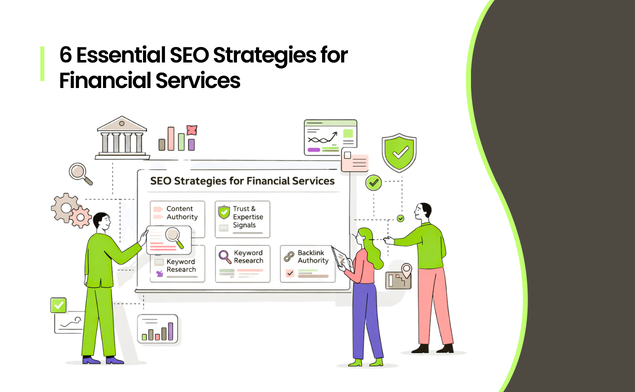

SEO for financial services is different from regular SEO.
If you are a bank, fintech startup, wealth manager, NBFC, insurance company, or investment advisory firm, you operate in one of the most competitive and tightly regulated search landscapes online.
But on the contrary, if you do get your SEO straight then the upside is massive.
Why is that ?
Well, according to stats, organic search delivers an average 5.3x return on investment for financial services, compared to just 2x from paid search. In fact, financial brands report an average SEO ROI of over 1,000%, one of the highest across all industries.
But here’s the catch.
Google holds financial websites to stricter quality standards because your content can directly impact someone’s savings, debt, retirement, or investments.
That means Higher scrutiny, Stronger credibility filters and More emphasis on authority.
Hence, generic SEO playbooks do not work in finance.
This guide breaks down the essential SEO strategies for financial services that build long term authority, satisfy compliance, survive algorithm shifts, and drive qualified leads.
Google classifies financial content under YMYL, which stands for “Your Money or Your Life.”
This category includes any content that can impact a person’s financial stability or future. Loans, credit cards, investments, taxes, insurance, retirement planning, wealth advisory, all fall under this umbrella.
Because of this, Google applies deeper evaluation layers.
Nearly 16,000 human search quality raters are used globally to assess the credibility and reliability of YMYL content. While they do not directly rank pages, their feedback trains Google’s systems to identify trustworthy financial information.
That means:
Therefore when doing SEO for financial service providers, accuracy and authority are not optional. They are ranking requirements.
E-E-A-T stands for: Experience, Expertise, Authoritativeness, Trustworthiness
In financial SEO, this framework directly influences performance.
Websites that fully implement strong E-E-A-T signals have been shown to see organic growth improvements nearly 27% faster than those that do not.
Why?
Because Google wants proof that you are qualified to advise people about money.
This means:
If your financial guides are written by subject matter experts and supported by credible data, your site builds ranking stability faster.
Financial services operate under strict regulatory oversight.
Your SEO team cannot operate in isolation from compliance teams. Every claim must be: Verifiable, Transparent, Region compliant, Risk disclosed
This affects how you structure content, landing pages, comparison pages, and even CTAs.
Finance SEO is not just about visibility. It is about visibility with accountability.
Trust is measurable in finance SEO.
Secure infrastructure, clear disclosures, regulatory identifiers, and transparent company details all reinforce ranking stability.
And trust also affects engagement.
According to stats, SEO-powered content marketing generates 54% more leads than traditional methods and improves conversion rates by around 13%. In finance, where customer acquisition costs are high, this makes organic trust-driven visibility even more valuable.
Authority builds rankings. Trust converts traffic.
In financial SEO, you need both working together.
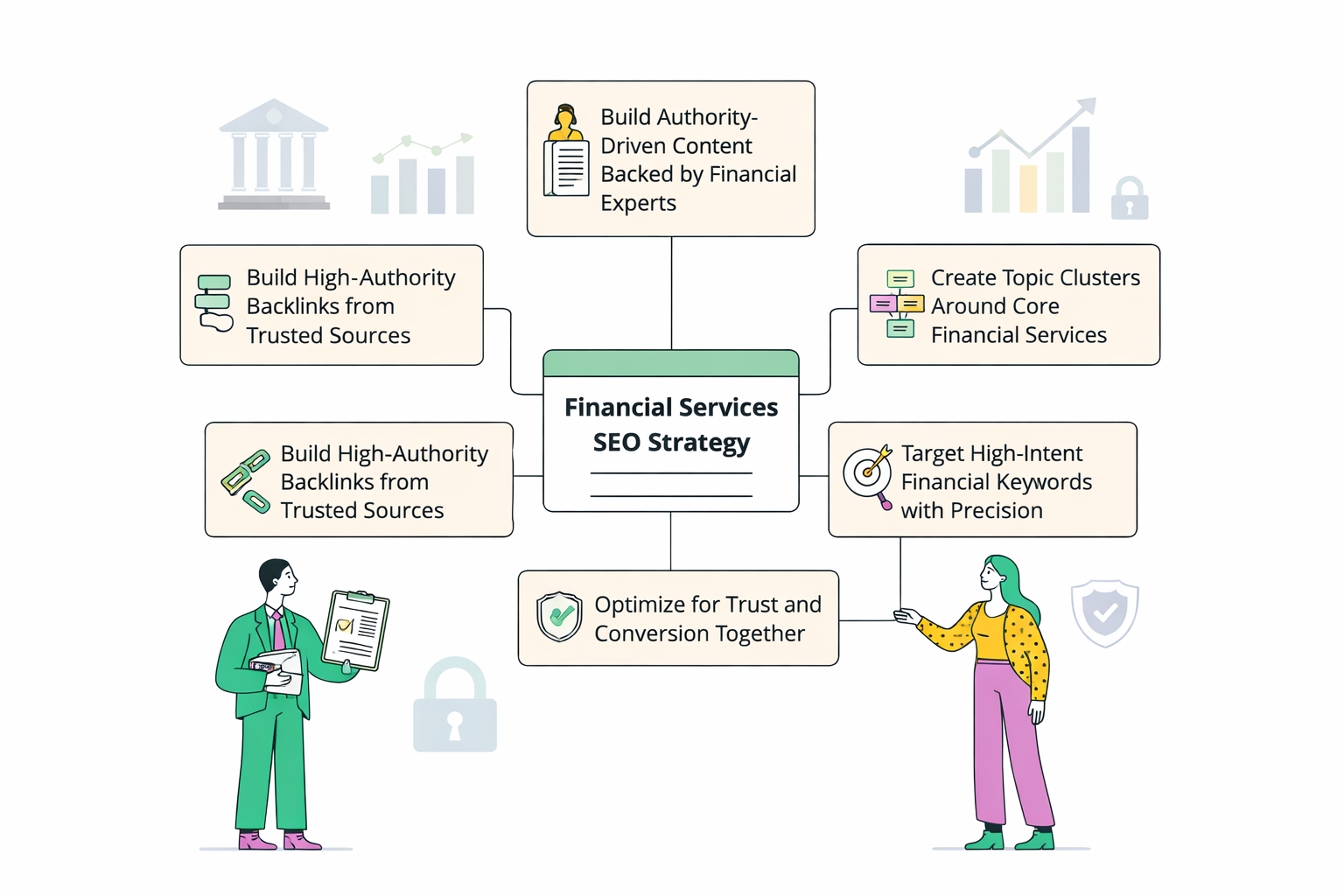
Financial SEO is not about publishing more blogs.
It is about building authority, structure, trust, and long term visibility in a high scrutiny environment.
And the opportunity is too big to ignore.
Financial services see an average SEO ROI of over 1,000 percent, making it one of the most profitable organic channels across industries. But that level of return only comes when the strategy is built correctly.
Let’s break down the strategies that actually move the needle.
In finance, content volume does not win.
Credibility wins. Always.
Because your website falls under YMYL, Google evaluates not just what you publish, but who is behind it.
Here’s what authority-driven content looks like in financial SEO:
When E-E-A-T signals are fully implemented, websites tend to see organic growth improvements nearly 27% faster compared to those that ignore them.
That means:
If your investment guide is reviewed by a certified financial planner and clearly displays their credentials, you are building algorithmic trust.
If your insurance comparison page includes data sources and compliance disclosures, you are strengthening ranking stability.
Anonymous content does not scale in finance. Expert-backed content does.
Financial SEO does not scale with random blog posts. It scales with structure.
Search engines want to see depth and authority around core financial topics. That means your site cannot just publish one article about loans and expect to rank for competitive terms like “business loan interest rates” or “best investment plan.”
You need clusters.
A topic cluster strategy organizes your content like this:
For example:
If your core service is “retirement planning,” your cluster may include:
All these pages internally link back to the main retirement planning service page and also to each other. This approach signals depth and authority to Google.
Why this matters even more today:
In 2024, around 60% of Google searches ended without a click. Users are getting answers directly on the results page or through AI summaries.
For financial firms, this changes the game.
You are not just competing for clicks. You are competing for visibility inside AI-generated answers.
Structured, well organized, and semantically connected content performs better in answer engine environments.
And there is another interesting pattern.
List-based articles account for roughly 25% of AI citations in generative search experiences. That means structured formats like:
are more likely to be referenced by AI systems.
But this does not mean you should turn everything into listicles.
It means structure matters.
A strong financial topic cluster does three things:
For financial services,creating topic clusters is imperative (than ever before). It is a visibility strategy for both traditional SEO and answer engine optimization.
Traffic alone does not grow financial businesses. Qualified intent based traffic does.
Financial services operate in a high-value acquisition environment. A single client for wealth management, lending, or insurance can be worth thousands over their lifetime.
That means your keyword strategy must focus on intent, not vanity metrics.
Just like any other industry there are three core intent layers in finance SEO.
These are education-driven searches like:
These queries build awareness and trust. They belong inside your topic clusters and nurture long-term authority.
These users are comparing options:
This is where comparison pages, structured list content, and feature breakdowns perform well.
These are high-conversion searches:
This is where optimized service pages matter the most.
Financial SEO ROI becomes powerful when you align content to these intent stages. Organic search already delivers significantly higher ROI than paid search in financial services. But that return multiplies when you prioritize keywords tied to real revenue actions.
Another important shift is how search behavior is evolving.
With the rising influence of AI search, financial firms must optimize content not just for rankings, but for answer visibility. That means:
When your page provides precise, structured answers, it increases its chances of being surfaced in AI summaries or featured snippets.
One more crucial factor in finance is that precision beats broad targeting.
For example: instead of chasing “investment” as a keyword, you focus on:
High-intent, problem-specific keywords drive higher-quality leads and lower acquisition costs.
Getting traffic in financial services is only half the job. If users do not trust you, they will not convert.
Finance is different from most industries because users are making high-stakes decisions. They are sharing personal data, financial details, and sometimes committing large sums of money. Even small trust gaps can kill conversions.
That means your SEO pages must be built for credibility and action at the same time.
Here is what that looks like in practice.
Do not hide disclaimers in footers. Place risk disclosures close to relevant claims.
For example:
Transparent language reduces hesitation.
Financial decisions require consideration.
Instead of aggressive CTAs like “Apply Now,” test softer but intent-driven CTAs such as:
When trust is high, conversion rates improve naturally. SEO-powered content marketing already generates 54 percent more leads than traditional outbound approaches. In finance, that lift becomes even more meaningful because acquisition costs are high.
Every form on a financial website should be reinforced with:
If users feel uncertain about data safety, they abandon it.
Include:
Financial buyers are risk-aware. Validation reduces perceived risk.
Trust is also technical.
Slow pages create friction. Broken layouts reduce credibility. Poor mobile optimization weakens user confidence.
A seamless experience reinforces brand reliability.
When trust and conversion design work together, organic traffic becomes profitable traffic.
In financial services, having a strong technical SEO builds reliability, security, and credibility for users as well as crawlers.
If your infrastructure feels unstable or unsafe, users will hesitate to take any action on your website. And search engines will also lose trust.
Financial websites must meet a higher technical standard because they handle sensitive information and complex user journeys.
Here are the core technical areas financial firms must prioritize.
Security is the baseline of trust online. Every page on a financial website must run on HTTPS. Beyond that, search engines evaluate whether your site demonstrates strong security practices such as:
For users submitting personal data like income details or investment information, visible security assurance reduces hesitation and increases engagement.
Page speed directly affects both user experience and rankings. Financial users often compare multiple providers. If your page takes too long to load, they simply move to the next option.
Optimizing performance involves:
A fast site communicates professionalism and reliability always.
A large share of financial research happens on mobile devices. People often compare loans, insurance plans, or investment options while commuting or browsing casually.
If your financial calculators, comparison tables, or forms are difficult to use on mobile, engagement drops quickly.
Mobile optimization should focus on:
Financial websites often grow large over time with many products and resources.
That’s why having an unclear structure makes search engines struggle to understand relationships between pages.
A strong architecture includes:
This helps both users and search engines navigate complex financial offerings.
Search engines increasingly rely on structured signals to understand content and its intent.
Adding structured data such as FAQ schema, article schema, and organization schema helps search engines interpret your content more accurately and increases your chances of appearing in rich results.
Technical SEO forms the backbone of financial search visibility. When performance, security, and clean structure work together, your site becomes both search-friendly and user-friendly at the same time.
In financial SEO, authority does not come only from what you publish. It also comes from who references you.
By definition, search engines treat backlinks as credibility signals. When trusted websites link to your content, it reinforces that your information is valuable and reliable.
But as we know that all backlinks are not equal.
When it comes to building links in financial services or in any other industry, quality matters far more than quantity. A handful of links from credible financial publications can have a stronger impact than hundreds of links from generic websites.
Here are the types of backlinks that carry real authority in the financial industry.
Links from well-known financial news sites, fintech publications, or investment platforms signal strong topical relevance.
Examples include:
These links position your brand as part of the broader financial conversation.
Original data is one of the most effective ways to earn natural backlinks.
For example:
Journalists, bloggers, and analysts frequently cite data sources when writing about financial trends. If your brand publishes credible research, it becomes a reference point. Simple.
Financial experts within your organization can contribute insights to industry publications, podcasts, or webinars.
When these contributions include links back to your site, they strengthen your authority profile.
This also helps with improving E-E-A-T signals because your experts are visible outside your own platform.
Digital PR helps financial brands earn coverage through newsworthy insights.
Examples include:
When journalists reference your analysis, they often include attribution links that strengthen your organic authority.
Backlinks from trusted sources do more than improve rankings.
They build a reputation.
And in the financial services industry, reputation is one of the strongest ranking signals a company can develop. A brand that is consistently cited by credible industry sources earns trust from both search engines and users.
In finance, trust is everything.
So from this entire article we have established one sure shot fact that SEO in financial services is not just about rankings. It is about trust, authority, and long term credibility.
From expert-backed content and structured topic clusters to technical performance and authoritative backlinks, the strategies covered in this guide help financial brands build sustainable organic visibility in a highly regulated space.
If your financial services company wants to strengthen its search presence and attract high intent clients, a specialized strategy makes all the difference.
Explore how our SEO services for finance companies help banks, fintech firms, investment platforms, and financial advisors grow through trusted organic search.
SEO for financial services is no longer optional—it’s essential. In the US, the three most popular financial news...
Read Case Study
AI Services





Link Building






Resources